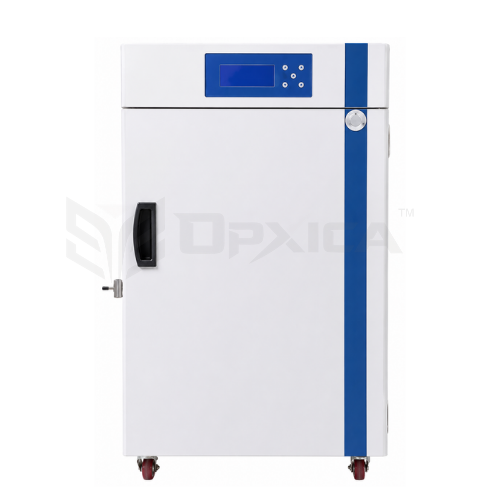
Description
Technical Specifications
| Specification | Standard Configuration | High-End / GMP Configuration |
|---|---|---|
| Product Name | Laboratory CO₂ Incubator | GMP CO₂ / Tri-Gas Incubator |
| Internal Model No. | OPX-CCI Standard Series | OPX-CCI Advanced Series |
| Product Type | Controlled-Atmosphere Cell Culture Incubator | High-Performance Cell Culture Incubator |
| Chamber Capacity | Approximately 50–200 Litres | Approximately 230–320+ Litres |
| Temperature Control | Microprocessor-Based Control | PID Temperature Regulation |
| Temperature Stability | Approximately ±0.1°C at 37°C | Approximately ±0.1°C at 37°C |
| Heating Method | Jacketed or Multi-Surface Heating | Six-Sided Direct Heating |
| CO₂ Control Range | Approximately 0.2%–20% | Approximately 0.2%–20% |
| CO₂ Sensor | Thermal Conductivity or Standard Sensor | Dual-Beam Infrared Sensor |
| Humidity System | Water Pan / Tray | Active Humidity Control |
| Relative Humidity | Up to Approximately 95% RH | Programmable or Actively Regulated |
| Water Supply | Internal Water Tray | External Water Reservoir Option |
| Oxygen Control | Ambient / Passive | Tri-Gas Control, Approximately 1%–21% O₂ |
| O₂ Sensor | Not Applicable in Standard Version | Zirconium-Based Oxygen Sensor |
| Decontamination | UV Lamp or Up to 140°C Dry Heat | Up to 180°C High-Heat Sterilization |
| Inner Chamber Material | Stainless Steel | High-Grade Stainless Steel |
| Outer Body | Powder-Coated Steel Cabinet | Powder-Coated or GMP-Compatible Exterior |
| Door Type | Insulated Outer Door with Inner Glass Door | Sealed Outer Door with Heated Glass Inner Door |
| Display | Digital Control Panel | Digital Microprocessor / Touchscreen Option |
| Alarm System | Temperature and CO₂ Deviation Alarm | Multi-Parameter Audio-Visual Alarm |
| Shelves | Adjustable Stainless Steel Shelves | Adjustable Perforated Stainless Steel Shelves |
| Data Monitoring | Optional Communication Port | Data Logging and Connectivity Options |
| Power Supply | 220–240 V AC, 50/60 Hz | 220–240 V AC, 50/60 Hz |
| Accuracy/Tolerance | Configuration Dependent | Application-Specific Precision Control |
| Calibration Standard | Factory Verification of Temperature and Gas Control | Multi-Point Temperature and Gas Calibration Option |
| Usage/Application | Cell Culture, Tissue Culture, IVF and Research | Pharmaceutical, Stem Cell, GMP and Advanced Biotechnology |
| Compliance | Standard Laboratory Manufacturing Practices | GMP-Oriented Configuration Available |
Features
- Controlled temperature, CO₂ concentration, and humidity for cell culture applications
- Chamber capacities suitable for small research laboratories and large institutional facilities
- Temperature stability of approximately ±0.1°C at 37°C
- Adjustable CO₂ concentration across a broad laboratory operating range
- Stainless steel chamber for corrosion resistance and simplified cleaning
- Inner glass door permits observation without fully disturbing chamber conditions
- Water-pan humidity system supports reduced media evaporation
- Dual-beam infrared CO₂ sensor available for advanced applications
- Tri-gas oxygen control available for hypoxic and specialized cell studies
- UV, dry-heat, or high-temperature sterilization options depending on configuration
Benefits
- Maintains repeatable environmental conditions for reliable cell growth
- Reduces contamination risk through smooth chamber surfaces and decontamination options
- Supports faster condition recovery after routine door openings
- Minimizes media loss by maintaining elevated chamber humidity
- Accommodates standard cell culture as well as specialized hypoxic research
- Provides scalable capacity for academic, pharmaceutical, and industrial laboratories
- Offers strong long-term procurement value through configurable control and sterilization systems
Available Variants
- Approximately 50 L compact laboratory CO₂ incubator
- Approximately 80 L bench-top CO₂ incubator
- Approximately 120 L cell culture incubator
- Approximately 160 L laboratory CO₂ incubator
- Approximately 200 L standard-capacity CO₂ incubator
- Approximately 230 L high-performance CO₂ incubator
- Approximately 300 L GMP-oriented CO₂ incubator
- Approximately 320+ L large-capacity customized incubator
Final dimensions, shelf quantities, and chamber capacity may vary according to the selected heating, gas-control, humidity, and sterilization configuration.
Optional Configurations
- Dual-beam infrared CO₂ sensor
- Tri-gas oxygen regulation from approximately 1% to 21%
- Zirconium oxygen sensor
- Active humidity control
- External water reservoir
- Six-sided direct heating
- Heated inner glass door
- UV decontamination lamp
- Dry-heat decontamination cycle up to 140°C
- High-temperature sterilization cycle up to 180°C
- Touchscreen control interface
- Data logging and USB connectivity
- Remote monitoring interface
- Additional stainless steel shelves
- Inner divided glass doors
- Access port for external sensors
- Custom chamber capacity and voltage configuration
Applications
- Mammalian cell culture
- Tissue culture and tissue engineering
- Stem cell research
- IVF and reproductive biology laboratories
- Cancer research
- Vaccine development
- Pharmaceutical research and development
- Biotechnology production laboratories
- Microbiological studies
- Hypoxia and oxygen-controlled research
- Medical college teaching laboratories
- Hospital and clinical research facilities
Why Choose Our Products
- Precision-controlled incubation systems manufactured under strict inspection procedures
- Multiple capacities for research, clinical, pharmaceutical, and institutional laboratories
- Configurable CO₂, oxygen, humidity, heating, and sterilization options
- Durable stainless steel chamber for dependable long-term laboratory use
- Technical support and bulk supply capability for projects, distributors, and institutions
Frequently Asked Questions
What is a laboratory CO₂ incubator used for?
A laboratory CO₂ incubator maintains controlled temperature, carbon dioxide, and humidity for growing mammalian cells and tissues. It is commonly used in cell culture, IVF, pharmaceutical research, cancer studies, biotechnology, and stem cell laboratories.
Why is CO₂ required in a cell culture incubator?
CO₂ works with bicarbonate-buffered culture media to help maintain the required pH. A stable gas concentration supports a consistent culture environment and reduces pH changes that could affect cell growth or experimental results.
What is the standard operating temperature for cell culture?
Many mammalian cell culture procedures operate at approximately 37°C. The incubator can be adjusted according to the selected biological protocol, with temperature stability commonly maintained around ±0.1°C in suitable configurations.
What CO₂ range is available?
The standard operating range may extend from approximately 0.2% to 20% CO₂. The exact control range, sensor type, and accuracy depend on the selected incubator configuration and laboratory application.
What is the difference between a standard and tri-gas incubator?
A standard CO₂ incubator regulates temperature, carbon dioxide, and humidity. A tri-gas incubator also regulates oxygen, allowing researchers to create hypoxic or oxygen-controlled conditions for stem cell, cancer, cardiovascular, and physiological studies.
Is an infrared CO₂ sensor better for cell culture?
A dual-beam infrared sensor provides stable gas measurement and is less affected by humidity or temperature changes than some conventional sensor systems. It is commonly selected for demanding research and GMP-oriented laboratory applications.
How is humidity maintained inside the chamber?
Standard units typically use a removable water pan to create elevated humidity, often approaching 95% RH. Advanced models may include active humidity control and an external reservoir for more consistent regulation.
What decontamination options are available?
Depending on the selected configuration, the incubator may include UV exposure, dry-heat decontamination up to approximately 140°C, or high-temperature sterilization up to approximately 180°C. The appropriate option depends on laboratory hygiene and validation requirements.
How often should a CO₂ incubator be calibrated?
Temperature and gas concentration should be verified according to the laboratory’s quality procedure, equipment usage, and regulatory requirements. Calibration is also recommended after relocation, major maintenance, sensor replacement, or unexpected performance deviation.
Can the incubator be customized for GMP laboratories?
Yes. GMP-oriented options may include stainless steel construction, infrared gas sensing, data recording, multi-level alarms, high-temperature sterilization, active humidity control, access control, and calibration documentation.
How should a CO₂ incubator be maintained?
The chamber, shelves, water pan, and door seals should be cleaned regularly using compatible disinfectants. Water quality, gas connections, filters, sensors, alarms, and calibration status should also be checked at planned intervals.
Do you supply CO₂ incubators in bulk?
Bulk procurement is available for universities, IVF centers, hospitals, pharmaceutical companies, biotechnology laboratories, research institutes, distributors, and government projects. Standard and customized configurations can be quoted according to quantity and technical requirements.
How is the CO₂ incubator packed for shipping?
The unit is secured with protective cushioning and rigid packaging suitable for laboratory equipment transport. Export shipments may be supplied in reinforced wooden packaging, with sensitive controls, doors, and accessories protected against transit movement.
What is the expected delivery timeline?
Lead time depends on chamber capacity, gas-control configuration, sterilization system, accessories, quantity, and customization. Standard models generally have shorter production schedules, while GMP and tri-gas units require additional manufacturing and testing time.
Call to Action
Looking for a dependable laboratory CO₂ incubator for cell culture, IVF, biotechnology, pharmaceutical research, or GMP applications? Opxica offers standard, infrared-sensor, tri-gas, active-humidity, and high-temperature sterilization configurations in multiple chamber capacities. Contact the sales team to request a technical quotation, institutional price, bulk supply proposal, or customized incubator recommendation.