Description
Technical Specifications
| Parameter | Specification |
|---|---|
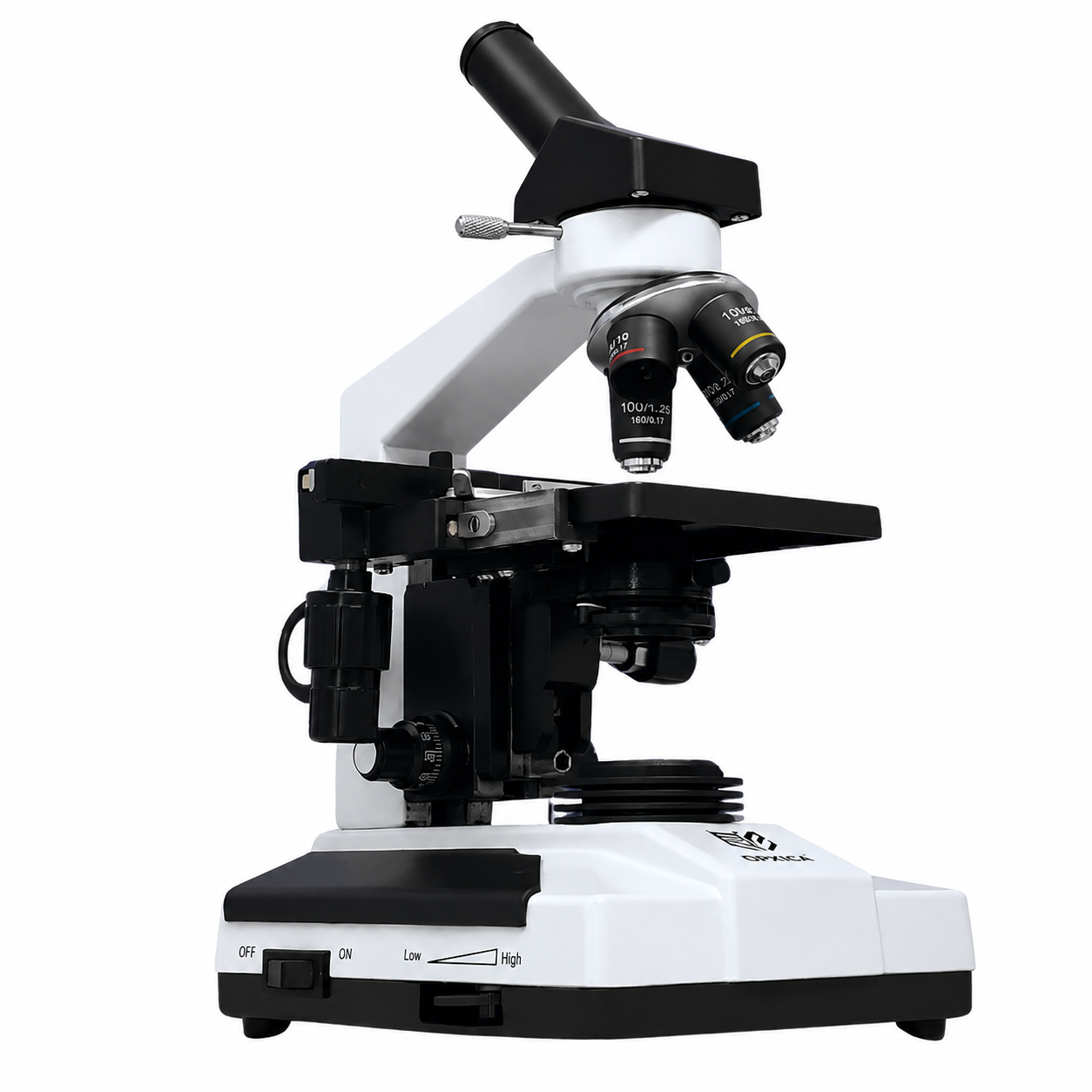
| Product Name | Advance Monocular Microscope AMM-124 |
| Model Number | AMM-124 |
| Microscope Type | Monocular Laboratory Microscope |
| Viewing Head | Monocular Head |
| Head Inclination | 45° Inclined |
| Head Rotation | 360° Rotatable |
| Eyepiece | WF10X Wide Field Eyepiece |
| Field Number | 18 mm |
| Objective Lenses | Plan Achromatic 4X, 10X, 40X (SL), 100X Oil |
| Magnification Range | 40X – 1000X |
| Nosepiece | Quadruple Revolving Nosepiece |
| Stage Type | Mechanical Stage |
| Stage Dimensions | 120 × 125 mm |
| Focusing System | Separate Coarse & Fine Focusing |
| Condenser | Abbe Condenser N.A. 1.25 |
| Diaphragm | Iris Diaphragm with Filter Slot |
| Illumination | LED Light with Intensity Control |
| Power Supply | 220V / 50Hz |
| Brand | OPXICA |
Key Features
High-Quality Plan Achromatic Optics
The Advance Monocular Microscope AMM-124 delivers bright, distortion-free images with enhanced contrast and resolution.
Wide Magnification Capability
Equipped with 4X, 10X, 40X, and 100X objectives, allowing detailed observation from basic to advanced specimen analysis.
Precision Mechanical Stage
Smooth specimen positioning enables accurate slide movement during laboratory examination.
Comfortable Monocular Viewing
The 45° inclined and 360° rotatable head reduces user fatigue and improves observation comfort.
LED Illumination System
Energy-efficient LED lighting provides uniform brightness and long operational life.
Fine & Coarse Focusing Controls
Dual focusing knobs allow precise specimen focusing for improved image sharpness.
Durable Laboratory Construction
Heavy-duty metal body ensures stability, reliability, and long-term laboratory use.
User-Friendly Operation
Designed for students, educators, laboratory technicians, and researchers.
Working Purpose
The Advance Monocular Microscope AMM-124 is developed to examine microscopic specimens that cannot be observed with the naked eye. It is widely used for:
- Studying plant and animal cells
- Observing microorganisms and bacteria
- Clinical and pathological investigations
- Educational demonstrations and laboratory training
- Biological and microbiological research
- Tissue and blood sample examination
- Scientific experiments and analysis
- Routine laboratory observations
Applications
- Schools & Science Laboratories
- Colleges & Universities
- Clinical Diagnostic Centers
- Pathology Laboratories
- Biotechnology Laboratories
- Research Institutes
- Medical Training Centers
- Microbiology Laboratories
Wrapping Notes
The Advance Monocular Microscope AMM-124 is a dependable laboratory instrument designed to provide precise and clear microscopic observations. Combining advanced plan achromatic optics, precision focusing, a robust mechanical stage, and efficient LED illumination, it meets the requirements of educational, clinical, and research environments. With superior optical performance and durable construction, the Advance Monocular Microscope AMM-124 represents OPXICA’s commitment to delivering high-quality microscopy solutions for modern laboratories and scientific institutions.
Frequently Asked Questions (FAQs)
1. What is a Monocular Microscope?
A monocular microscope is an optical microscope that uses a single eyepiece for specimen observation. It is widely used in schools, colleges, biology laboratories, research centers, and educational institutions for studying microorganisms, tissues, cells, and biological specimens. The OPXICA Advance Monocular Microscope AMM-124 delivers sharp optical performance, user-friendly operation, and reliable results for routine laboratory work.
2. What is the working principle of a monocular microscope?
The working principle of a monocular microscope is based on the refraction of light through a series of optical lenses. Light passes through the specimen and objective lens before being magnified by the eyepiece, producing a clear and enlarged image for detailed observation. The OPXICA AMM-124 features precision optical components that provide bright, high-contrast images for educational and laboratory applications.
3. What are the main parts of a monocular microscope?
A monocular microscope consists of several essential components, including:
- Monocular viewing head
- Wide-field eyepiece
- Objective lenses
- Revolving nosepiece
- Mechanical stage
- Condenser
- Iris diaphragm
- LED illumination system
- Coarse and fine focusing knobs
- Stable metal base
Each component contributes to accurate specimen observation and smooth microscope operation.
4. What is the difference between a monocular microscope and a binocular microscope?
A monocular microscope has one eyepiece and is ideal for educational, training, and routine laboratory applications. A binocular microscope features two eyepieces, providing more comfortable viewing during extended use while reducing eye strain. Both microscopes offer excellent image quality, but binocular models are generally preferred for prolonged laboratory work and research.
5. What is the magnification range of the OPXICA AMM-124 Monocular Microscope?
The OPXICA Advance Monocular Microscope AMM-124 is designed for biological and laboratory observations using high-quality plan achromatic optics. The available magnification depends on the installed eyepiece and objective lens combination, making it suitable for routine educational and laboratory microscopy.
6. What are the applications of a monocular microscope?
The OPXICA AMM-124 is suitable for a wide range of applications, including:
- Biology laboratories
- School and college practicals
- Clinical laboratory demonstrations
- Microbiology studies
- Tissue examination
- Cell observation
- Educational training
- Scientific research
- Laboratory specimen analysis
Its precision optics make it suitable for both academic and professional environments.
7. Is the OPXICA AMM-124 suitable for students?
Yes. The OPXICA Advance Monocular Microscope AMM-124 is an excellent choice for students because it offers easy operation, durable construction, clear image quality, and reliable performance. It is commonly used in schools, colleges, universities, and teaching laboratories for practical science education.
8. Why choose a monocular microscope instead of a binocular microscope?
A monocular microscope is often preferred for educational laboratories because it is lightweight, cost-effective, easy to operate, and requires minimal maintenance. It provides excellent optical performance for routine biological observations while remaining affordable for schools, colleges, and training institutions.
9. What is the price of a monocular microscope?
The price of a monocular microscope depends on factors such as optical quality, magnification, illumination system, stage design, accessories, and build quality. Educational models are generally more economical, while advanced laboratory microscopes with precision optics and enhanced features are available at higher price points. Contact OPXICA for the latest pricing and institutional quotations.
10. What makes the OPXICA Advance Monocular Microscope AMM-124 different?
The OPXICA AMM-124 combines plan achromatic optics, precision focusing, an adjustable LED illumination system, a mechanical stage, and durable metal construction. Its ergonomic design and dependable optical performance make it suitable for schools, colleges, laboratories, and research facilities requiring accurate microscopic observation.
11. Can the OPXICA AMM-124 be used in clinical and research laboratories?
Yes. The OPXICA Advance Monocular Microscope AMM-124 is suitable for routine clinical observations, biological research, microbiology studies, pathology demonstrations, educational laboratories, and scientific training programs where accurate specimen visualization is required.
12. Does the OPXICA AMM-124 include LED illumination?
Yes. The OPXICA Advance Monocular Microscope AMM-124 features an adjustable LED illumination system that provides bright, uniform lighting for improved specimen visibility while offering energy-efficient and long-lasting performance.
13. How do I maintain a monocular microscope?
To maintain optimal performance:
- Clean optical lenses using lens paper and approved lens cleaner.
- Keep the microscope covered when not in use.
- Store it in a clean, dry environment.
- Avoid touching optical lenses with bare fingers.
- Check illumination and focusing mechanisms regularly.
- Handle the microscope carefully during transportation.
Proper maintenance ensures consistent image quality and extends the microscope’s service life.
14. Is the OPXICA AMM-124 available for institutional and bulk orders?
Yes. OPXICA supplies the Advance Monocular Microscope AMM-124 to schools, colleges, universities, hospitals, laboratories, distributors, government organizations, and research institutions. Bulk supply, OEM manufacturing, and customized branding solutions are also available.
15. Where can I buy the OPXICA Advance Monocular Microscope AMM-124?
The OPXICA Advance Monocular Microscope AMM-124 can be purchased directly from OPXICA. For product specifications, pricing, bulk inquiries, institutional purchases, and technical assistance, contact the OPXICA sales team through the official website or authorized representatives.