
Importance of Microscope in Our Daily Life
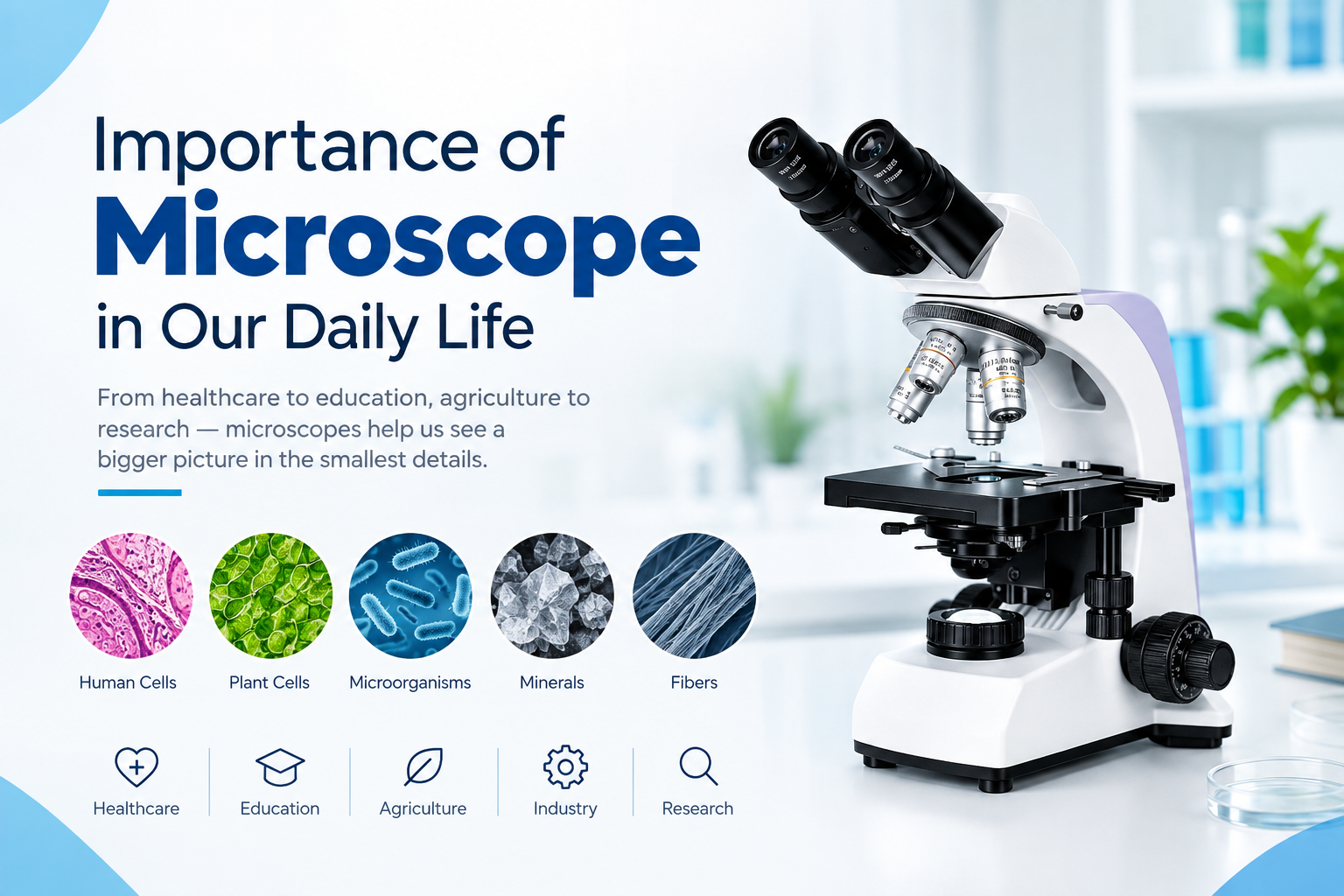
When most people hear the word “microscope,” they think about school science labs, scientists, or medical laboratories. But microscopes are used in many more areas than we usually realize. They help us see and examine things that are too small to be clearly observed with our eyes.
A microscope does not make small things bigger just for viewing. It helps people study details, identify problems, compare materials, and make better decisions in different fields.
What Is the Importance of a Microscope?
The main importance of a microscope is its ability to magnify small objects and reveal details that are difficult or impossible to see with the naked eye.
For example, a doctor or laboratory technician may use a microscope to examine cells or microorganisms. A student can use one to observe plant cells. In manufacturing, microscopes can help inspect small components and surface defects.
This makes the microscope a useful tool for education, healthcare, research, agriculture, manufacturing, jewellery, laboratories, and many other applications.
1. Microscopes Help in Medical Testing
One of the most important uses of microscopes is in healthcare and laboratory testing.
Blood, urine, tissue samples, and other specimens can contain structures that cannot be properly examined with the naked eye. Laboratory professionals use microscopes to observe cells, microorganisms, crystals, and other small structures.
Microscopic examination can form part of the process used to investigate infections, blood-related conditions, tissue abnormalities, and other medical problems.
The microscope itself does not diagnose a disease. Instead, it provides visual information that trained professionals can use along with other tests and clinical information.
2. Microscopes Make Science Easier to Understand
For students, a microscope can turn an abstract science lesson into something they can actually observe.
A textbook may show a diagram of a plant cell, but looking at a prepared slide through a microscope gives students a different experience. They can observe structures such as cells, tissues, and microorganisms directly.
This is particularly useful in biology classes because many biological structures are too small to see without magnification.
3. They Are Used to Study Microorganisms
Bacteria, fungi, protozoa, and other microorganisms are often studied using microscopes.
Researchers and laboratory workers can examine their shape, structure, movement, and other characteristics depending on the type of microscope and sample preparation being used.
Microscopy has therefore played an important role in microbiology and continues to be used alongside modern laboratory techniques.
4. Microscopes Are Useful in Agriculture
Microscopy also has applications in agriculture.
Plant tissues, seeds, soil samples, fungi, pests, and other biological materials can be examined under magnification. Researchers and agricultural laboratories may use microscopes to study plant diseases and microscopic organisms associated with crops.
For farmers, the microscope is usually not a daily household tool. However, the information obtained through agricultural laboratories can support decisions related to crop health and research.
5. Microscopes Help in Food Testing
Food quality and safety laboratories also use microscopes.
Microscopic examination can help identify certain microorganisms, foreign particles, crystals, starch structures, and other characteristics of food samples.
Different types of food require different testing methods, so microscopy is generally one part of a larger testing process rather than a complete quality test by itself.
6. Their Role in Jewellery and Gemstone Inspection
A microscope can be very useful when examining jewellery, gemstones, diamonds, and other small objects.
Under magnification, an inspector can observe small scratches, inclusions, surface marks, settings, finishing details, and other features that may be difficult to see normally.
Jewellery professionals often need a clear view of very small areas, which is why stereo microscopes are commonly used for detailed inspection and repair work.
7. Microscopes Are Used in Electronics and Manufacturing
Modern electronic components can be extremely small. Manufacturers and technicians sometimes use microscopes to inspect circuit boards, solder joints, connectors, components, and other fine details.
Magnification can make it easier to identify manufacturing defects, damaged parts, contamination, or connection problems.
Similar inspection methods are used in other industries where small components or fine surface details need to be checked.
8. They Help Researchers Discover New Things
Research is another major area where microscopes are important.
Scientists use different microscopy techniques to study cells, tissues, materials, microorganisms, minerals, and many other subjects.
The type of microscope depends on what needs to be observed. A basic light microscope may be suitable for some samples, while specialized research may require advanced optical or electron microscopy.
Microscopes have helped researchers observe structures that would otherwise remain hidden from direct observation.
9. Microscopes Help Us Understand Plants
Even something as familiar as a leaf contains structures that cannot be seen clearly with the naked eye.
With a microscope, students and researchers can observe plant cells, tissues, stomata, pollen, and other microscopic structures.
This helps explain how plants are organized and how processes such as gas exchange take place at the cellular level.
10. Microscopes Are Useful for Quality Inspection
Microscopes are also used when a product needs to be inspected at a very small scale.
Depending on the industry, workers may examine metal surfaces, plastics, coatings, fibres, components, welds, or other materials.
Small cracks, scratches, particles, and manufacturing defects can sometimes become easier to identify under magnification.
11. Microscopes Are Important in Forensic Work
Microscopy can also be used in forensic laboratories.
Small pieces of evidence such as fibres, hair, particles, residues, and other materials may be examined using different types of microscopes.
The purpose is often to compare or characterize microscopic features. Such examination is generally combined with other forensic methods rather than being used alone.
12. They Help in Everyday Learning
You do not need to be a scientist to benefit from understanding microscopy.
A microscope can make ordinary objects interesting. A small piece of plant tissue, a drop of water, salt crystals, fabric fibres, or other materials can look completely different when viewed under magnification.
For students and curious learners, this can make science more practical and easier to explore.
Why Can’t We See These Things With Our Eyes?
The human eye has a limited ability to distinguish very small details. When objects or structures become smaller than our visual resolution, they appear blurred or may not be visible at all.
A microscope uses lenses and illumination, or other imaging methods depending on the instrument, to produce a magnified image and reveal details that the unaided eye cannot resolve.
This is why a microscope is more than simply a stronger version of a magnifying glass. Its optical design allows much greater magnification and resolution.
Different Uses Need Different Microscopes
There is no single microscope that is ideal for every purpose.
For example:
- Compound microscopes are commonly used for cells, tissues, and prepared slides.
- Stereo microscopes are useful for three-dimensional objects, jewellery, electronics, and detailed inspection.
- Digital microscopes can display magnified images on a computer or screen.
- Trinocular microscopes can be used when observation and image capture are required at the same time.
- Electron microscopes are used for extremely high-resolution research applications.
The right microscope depends on the sample, required magnification, resolution, working distance, illumination, and purpose of observation.
Importance of Microscopes in Simple Words
A microscope helps us answer a simple question: What is actually there when something is too small to see clearly?
It allows us to look beyond what our eyes can normally detect.
From a biology classroom to a medical laboratory, from jewellery inspection to industrial quality control, microscopy gives people a way to examine small details more closely.
We may not use a microscope every day at home, but many areas of modern life depend on work that involves microscopy. The food we test, the medical samples we examine, the products we manufacture, and the scientific knowledge we develop can all involve microscopic observation.
Final Thoughts
The importance of a microscope is not limited to science laboratories. Its real value comes from giving us information that normal eyesight cannot provide.
For students, it makes learning more practical. For laboratory professionals, it helps with sample examination. For researchers, it provides a way to study structures at a much smaller scale. For technicians and inspectors, it can help reveal defects and details.
In simple terms, a microscope helps us see what our eyes cannot see clearly. That ability makes it useful across many parts of science, healthcare, education, industry, and research.
