Description
Technical Specifications
| Parameter | Specification |
|---|---|
| Product Name | Research Polarizing Microscope RPM-168 |
| Microscope Type | Research Polarizing Microscope |
| Optical System | Infinity Corrected Strain-Free Optical System |
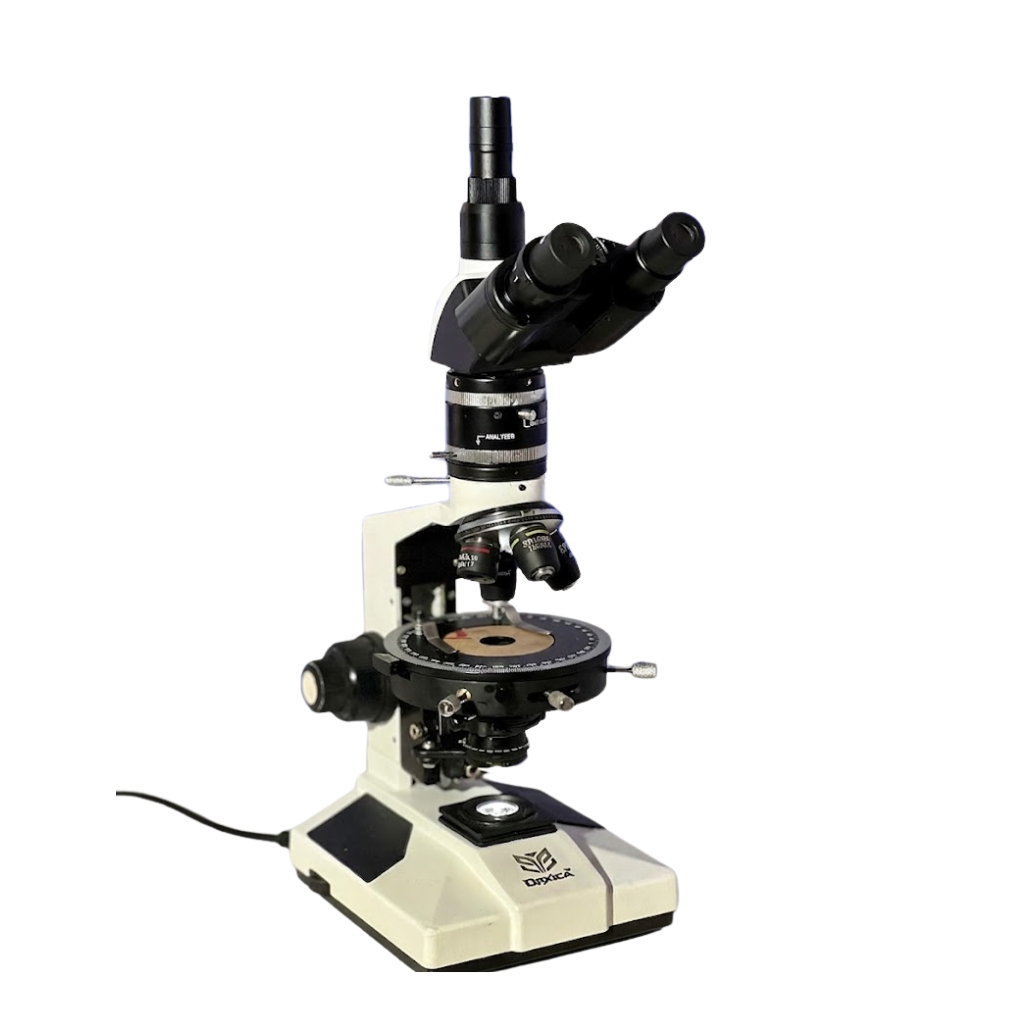
| Viewing Head | Trinocular Siedentopf Observation Head, 30° Inclined |
| Interpupillary Distance | 48–75 mm |
| Eyepieces | Wide Field WF10X/22 mm with Diopter Adjustment |
| Objectives | Strain-Free Plan Achromatic 4X, 10X, 20X, 40X, 60X (Optional 100X Oil) |
| Nosepiece | Quintuple Revolving Nosepiece |
| Magnification Range | 40X–1000X |
| Polarizer | Rotatable 360° Polarizer |
| Analyzer | Swing-Out Analyzer |
| Bertrand Lens | Built-in Bertrand Lens for Conoscopic Observation |
| Compensator Slot | Yes |
| Stage | Precision 360° Graduated Circular Rotating Stage |
| Stage Diameter | 160 mm Approx. |
| Condenser | Strain-Free Polarizing Condenser with Iris Diaphragm |
| Focusing | Coaxial Coarse & Fine Focusing System |
| Fine Focus Accuracy | 0.002 mm |
| Illumination | High Brightness LED Köhler Illumination |
| Filters | Blue, Green, Yellow & Frosted Filters |
| Body | Heavy Duty Metal Construction |
| Camera Port | Trinocular Photo Port |
| Digital Camera Compatibility | Yes |
| Power Supply | AC 100–240V, 50/60Hz |
| Applications | Petrography, Mineralogy, Crystallography, Materials Science, Metallurgy, Ceramics, Semiconductor Inspection, Research |
Key Features
- Research-grade strain-free infinity optical system
- Crystal-clear polarized image observation
- Orthoscopic and conoscopic observation modes
- Precision rotating 360° graduated stage
- High-quality polarizer and analyzer assembly
- Built-in Bertrand lens for interference figure analysis
- Swing-out analyzer for easy switching
- Wide-field observation with excellent edge sharpness
- High numerical aperture objectives
- Smooth coaxial coarse and fine focusing mechanism
- LED Köhler illumination for uniform brightness
- Trinocular head for digital imaging and documentation
- Rugged metal body designed for continuous laboratory operation
- Compatible with digital microscope cameras
- Excellent optical contrast and color accuracy
- Suitable for education, research, industrial inspection, and geological laboratories
Working Principle of Research Polarizing Microscope RPM-168
The Research Polarizing Microscope RPM-168 operates on the principle of polarized light microscopy, where plane-polarized light interacts with anisotropic materials. When polarized light passes through birefringent specimens such as minerals or crystals, the material alters the light’s vibration direction and phase.
The analyzer positioned above the objective lens combines with the polarizer below the specimen to generate interference colors, extinction patterns, and optical characteristics. By rotating the specimen on the graduated circular stage, researchers can examine crystal orientation, optical sign, birefringence, cleavage, twinning, and internal stress distribution.
The integrated Bertrand lens enables conoscopic observation for studying interference figures and optic axes, making the RPM-168 ideal for advanced mineralogical and crystallographic investigations.
Applications
The Research Polarizing Microscope RPM-168 is widely used in:
- Geological Survey Laboratories
- Petrography Laboratories
- Mineral Identification
- Crystallography Research
- Metallurgical Analysis
- Ceramic Industry
- Semiconductor Inspection
- Glass Manufacturing
- Textile Fibre Analysis
- Polymer Research
- Pharmaceutical Material Analysis
- Chemical Research Laboratories
- Universities & Colleges
- Forensic Science Laboratories
- Materials Science Research Centers
Advantages
- High optical precision
- Excellent polarized image quality
- Stable research-grade construction
- Accurate mineral identification
- Superior crystal analysis capability
- Easy orthoscopic and conoscopic switching
- Uniform LED illumination
- Long service life
- Camera-ready trinocular design
- Low maintenance requirements
Why Choose the Research Polarizing Microscope RPM-168?
The Research Polarizing Microscope RPM-168 is engineered for professionals who require reliable, high-resolution polarized light imaging. Its precision optics, advanced polarization accessories, robust mechanical construction, and compatibility with digital imaging systems make it an excellent choice for geological research, material characterization, crystallography, and industrial quality control. Whether used in universities, research institutes, or manufacturing laboratories, RPM-168 delivers consistent analytical performance and dependable long-term operation.
Frequently Asked Questions (FAQ)
What is the Research Polarizing Microscope RPM-168 used for?
The RPM-168 is used to examine birefringent materials such as minerals, crystals, rocks, ceramics, polymers, glass, and metals under polarized light.
What is polarized light microscopy?
Polarized light microscopy uses polarized light and specialized optical components to reveal optical properties that cannot be observed using conventional bright-field microscopy.
Can the RPM-168 perform conoscopic observation?
Yes. The microscope includes a built-in Bertrand lens that supports both orthoscopic and conoscopic observation methods.
Which industries commonly use a Research Polarizing Microscope?
It is commonly used in geology, mineralogy, metallurgy, semiconductor manufacturing, ceramics, materials science, forensic science, universities, and industrial quality control laboratories.
Does the RPM-168 support digital imaging?
Yes. The trinocular observation head allows connection to compatible digital microscope cameras for image capture, documentation, and analysis.
What specimens can be observed?
The microscope is suitable for:
- Thin rock sections
- Minerals
- Crystals
- Glass
- Ceramics
- Textile fibres
- Polymers
- Semiconductor wafers
- Stress analysis samples
What is the magnification range?
Depending on the objective lenses and eyepieces installed, the RPM-168 typically offers a magnification range of 40X to 1000X.
What is the difference between a polarizing microscope and a compound microscope?
A polarizing microscope includes a polarizer, analyzer, rotating stage, and polarization accessories to analyze anisotropic materials, while a standard compound microscope is primarily designed for general biological specimen observation.