Description
Model Number: OPX-281
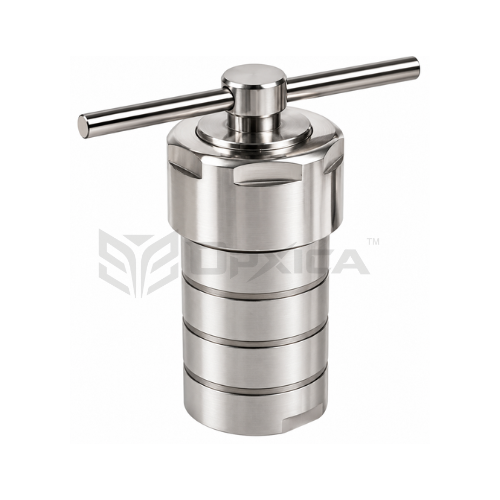
Product Name: Hydrothermal Autoclave
Brand Name: OPXICA
Chamber Capacity: 100 mL
The OPXICA OPX-281 Hydrothermal Autoclave is a high-pressure laboratory reactor designed for hydrothermal and solvothermal synthesis under controlled temperature and pressure conditions. Manufactured with a robust SS 316 outer vessel, it is suitable for research involving chemical synthesis, nanoparticles, catalysts, crystals, advanced materials, and other compatible laboratory processes.
Technical Specifications
| Parameter | Specification |
|---|---|
| Model Number | OPX-281 |
| Product Name | Hydrothermal Autoclave |
| Brand Name | OPXICA |
| Product Type | Hydrothermal / High-Pressure Reactor |
| Chamber Volume | 100 mL |
| Maximum Temperature | 230°C* |
| Maximum Pressure | 3 MPa* |
| Vessel Material | SS 316 |
| Outer Shell | SS 316 |
| Heating Type | Jacketed |
| Shape | Cylindrical |
| Reactor Configuration | Threaded Type |
| Available Capacity Range | 10 mL to 2000 mL |
| Liner Options | PTFE (Teflon) / PPL |
| PTFE Maximum Temperature | Up to 220°C |
| PTFE Recommended Safe Limit | 200°C |
| PPL Maximum Temperature | Up to 280°C |
| PPL Recommended Safe Limit | 260°C |
| Application | Hydrothermal & Solvothermal Research |
| Typical Use | Chemical, Nanoparticle, Catalyst & Crystal Synthesis |
| Recommended Filling | Not More Than 90% of Vessel Capacity |
*The usable temperature and pressure must follow the limits of the complete reactor configuration, including the liner and manufacturer-rated operating conditions.
Key Features
- 100 mL chamber capacity
- Heavy-duty SS 316 outer construction
- Designed for hydrothermal and solvothermal reactions
- Maximum specified pressure up to 3 MPa
- Cylindrical, compact laboratory configuration
- Jacketed reactor construction
- Available with PTFE (Teflon) or PPL liner options
- Suitable for elevated-temperature laboratory synthesis
- Designed for high-pressure reaction environments
- Threaded closure design for smaller-capacity reactors
- Suitable for nanoparticle and nanomaterial synthesis
- Useful for catalyst and crystal preparation
- Suitable for research and development laboratories
- Available in multiple capacities for different research requirements
- Designed for controlled scientific and material-synthesis applications
Hydrothermal & Solvothermal Research
The OPX-281 is designed for hydrothermal and solvothermal synthesis, where compatible chemical reactions are carried out in a sealed vessel under elevated temperature and pressure.
These techniques are widely used in materials science and research for producing or studying nanomaterials, crystalline compounds, catalysts, ceramics, and other advanced materials under controlled laboratory conditions.
SS 316 Construction
The outer reactor vessel is manufactured from SS 316 stainless steel, providing robust mechanical construction for laboratory applications. The stainless-steel outer jacket surrounds and supports the inner reaction chamber.
The actual chemical compatibility of the reactor depends on the liner material, reagents, temperature, pressure, concentration, and complete reactor configuration.
PTFE (Teflon) Lined Reactor
The PTFE-lined configuration is intended for compatible hydrothermal applications requiring chemical resistance. Based on the supplied specifications, the PTFE liner has a stated maximum temperature of approximately 220°C, with a recommended safe working limit of 200°C.
Operating limits should always follow the rating supplied with the specific liner and complete reactor assembly.
PPL Lined Reactor
For applications requiring higher temperature capability, a PPL-lined configuration may be used where compatible with the intended process.
According to the supplied specifications, PPL liners can support temperatures up to approximately 280°C, with a recommended working limit of around 260°C, subject to the rating of the actual reactor configuration.
Available Capacity Range
The Hydrothermal Autoclave series can be supplied in multiple capacities depending on laboratory requirements.
Threaded Type: Typically available from 10 mL to 500 mL.
Flange Type: Larger configurations may be available in 1 L, 1.5 L, and 2 L capacities.
The OPX-281 featured here has a 100 mL chamber capacity.
Working Purpose
The OPXICA OPX-281 Hydrothermal Autoclave provides a sealed reaction environment for compatible laboratory synthesis requiring elevated temperature and pressure. It is particularly useful in research involving material formation and chemical transformations that require hydrothermal or solvothermal conditions.
Researchers can use this type of reactor for applications involving nanoparticle synthesis, crystal growth, catalyst development, materials research, and chemical synthesis, provided the process remains within the rated limits of the reactor and liner.
Applications
The OPX-281 is suitable for:
- Hydrothermal synthesis
- Solvothermal synthesis
- Nanoparticle research
- Nanomaterial synthesis
- Crystal growth studies
- Catalyst synthesis
- Materials science research
- Chemical research
- Advanced material development
- Academic research laboratories
- Research and development facilities
- Institutional laboratories
- Compatible industrial R&D
- Quality-control and analytical research
Laboratory Safety & Operating Considerations
Because a hydrothermal autoclave operates under elevated temperature and pressure, it should only be operated by trained laboratory personnel according to the manufacturer’s operating manual and institutional safety procedures.
The reactor, liner, seals, threads, and closure components should be inspected before operation. Do not exceed the rated temperature, pressure, or filling limits of the specific assembly. The supplied guidance recommends keeping the filling level at 90% or less; some reactions may require a lower limit, so the validated procedure and manufacturer instructions should take priority.
The reactor should be allowed to cool and depressurize fully according to the manufacturer’s procedure before opening. Proper cleaning between compatible experiments is important to minimize contamination.
At the End
The OPXICA OPX-281 Hydrothermal Autoclave provides a specialized solution for scientific research involving elevated-temperature and elevated-pressure reactions. Its 100 mL chamber, SS 316 construction, and compatibility with specialized inner liners support a broad range of hydrothermal and solvothermal research applications.
For reliable operation, users should always follow the specified limits for the particular reactor body, liner, seals, temperature, pressure, and chemical system being used.
Frequently Asked Questions (FAQs)
1. What is the OPXICA OPX-281 Hydrothermal Autoclave?
The OPX-281 is a 100 mL high-pressure laboratory reactor designed for hydrothermal and solvothermal research applications.
2. What is the capacity of the OPX-281?
The specified chamber volume is 100 mL.
3. What is the maximum specified temperature?
The supplied specification lists a maximum temperature of 230°C for the reactor. However, the allowable operating temperature can be lower depending on the liner and complete reactor configuration.
4. What is the maximum pressure?
The supplied specification states a maximum pressure of 3 MPa. Users must remain within the rated limits of the specific assembled reactor.
5. What material is used for the outer vessel?
The reactor uses SS 316 stainless-steel construction for the specified outer vessel and shell.
6. What types of liners are available?
Hydrothermal reactors can be supplied with PTFE (Teflon) or PPL liners, depending on the intended operating conditions.
7. What is the temperature limit of a PTFE liner?
According to the supplied information, the PTFE liner has a maximum temperature of approximately 220°C, with a recommended safe working limit of around 200°C.
8. What is the temperature limit of a PPL liner?
The supplied information specifies a maximum temperature of approximately 280°C and a recommended safe limit of around 260°C for PPL.
9. What is hydrothermal synthesis?
Hydrothermal synthesis is a laboratory technique in which compatible materials undergo reactions in a sealed environment under elevated temperature and pressure.
10. Can the OPX-281 be used for nanoparticle synthesis?
Yes. Nanoparticle and nanomaterial synthesis are common research applications for compatible hydrothermal reactor systems.
11. Can it be used for crystal synthesis?
Yes. Hydrothermal reactors are commonly used in compatible crystal-growth and crystalline-material research.
12. Can the reactor be used for catalyst research?
Yes. The OPX-281 can support compatible research involving catalyst synthesis and materials development.
13. What shape is the OPX-281?
The reactor has a cylindrical configuration.
14. What type of heating configuration is specified?
The supplied specification describes the unit as having a jacketed heating configuration.
15. Is the OPX-281 suitable for research institutions?
Yes. It is intended for research laboratories, universities, scientific institutions, R&D facilities, and compatible industrial research applications.
16. What is the recommended maximum filling level?
The supplied information states that the reactor should not be filled beyond 90% of its capacity. The validated procedure or manufacturer may specify a lower limit for particular reactions.
17. Are other capacities available?
Yes. Hydrothermal reactor configurations are available in capacities ranging from approximately 10 mL to 2000 mL, depending on design and requirements.
18. What is the difference between threaded and flange configurations?
Smaller reactors are commonly supplied with threaded closures, while larger-capacity systems may use bolted flange arrangements. The exact configuration depends on reactor capacity and design.
19. Can corrosive chemicals be used?
Chemical compatibility depends on the liner, seals, concentration, temperature, pressure, and specific chemical involved. Compatibility should be verified before use rather than assuming the reactor is suitable for every corrosive material.
20. Why choose the OPXICA OPX-281?
The OPXICA OPX-281 combines a compact 100 mL chamber, SS 316 construction, specialized liner options, and a high-pressure reactor design for hydrothermal, solvothermal, nanoparticle, catalyst, crystal, and advanced materials research.