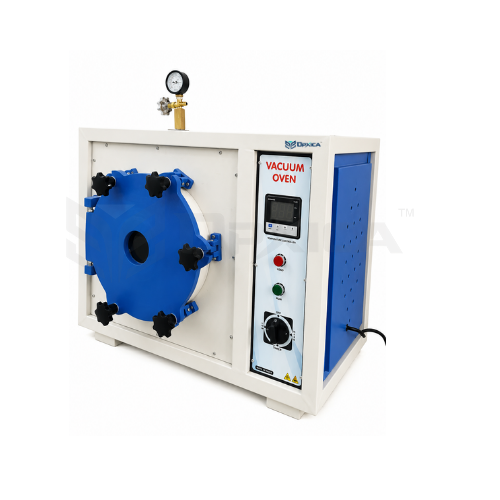
Description
Product Specifications
| Specification | Details |
|---|---|
| Product Name | Round Vacuum Oven |
| Model | OPX-206 |
| Product Type | Laboratory Vacuum Oven |
| Chamber Material | Heavy Gauge Stainless Steel |
| Exterior Material | Powder-Coated Mild Steel |
| Construction | Double-Walled with Glass Wool Insulation |
| Door | Heat-Treated Glass Viewing Door |
| Door Seal | Silicone Vacuum Gasket |
| Temperature Range | 50°C Above Ambient to 150°C |
| Temperature Control | Thermostatic Controller |
| Heating Method | Electric Heating |
| Power Supply | 220–230V AC, 50 Hz |
| Applications | Pharmaceutical, Chemical, Electronics, Research & Industrial Laboratories |
Available Variants
| Model | Chamber Size | Approx. Capacity |
|---|---|---|
| OPX-206A | 10″ × 12″ | 12 Litres |
| OPX-206B | 12″ × 12″ | 24 Litres |
| OPX-206C | 12″ × 24″ | 40 Litres |
Custom chamber sizes and electrical configurations are available upon request.
FAQs
What is a Round Vacuum Oven used for?
A Round Vacuum Oven is used for drying, curing, degassing, and heat treatment of moisture-sensitive or heat-sensitive materials under reduced pressure while minimizing oxidation.
Which industries commonly use a Round Vacuum Oven?
It is widely used in pharmaceutical manufacturing, chemical processing, biotechnology, electronics, semiconductor production, universities, research laboratories, food processing, and industrial quality control.
Why is vacuum drying preferred?
Vacuum drying lowers the boiling point of liquids, allowing materials to dry faster at lower temperatures while protecting them from oxidation and thermal degradation.
What is the operating temperature range?
The standard model operates from 50°C above ambient up to 150°C, making it suitable for most laboratory drying and thermal processing applications.
Does the oven allow sample observation?
Yes. A heat-treated glass viewing window enables operators to observe samples without opening the chamber and disturbing the vacuum environment.
Can the oven be customized?
Yes. Chamber size, temperature controller, electrical configuration, shelving, and other specifications can be customized according to laboratory or industrial requirements.
Why Choose Our Products
- Heavy-duty laboratory-grade construction
- Corrosion-resistant stainless steel chamber
- Uniform heating with excellent thermal insulation
- Reliable vacuum sealing system
- Custom-built configurations available
- Strict quality inspection before dispatch
- Technical support and OEM manufacturing capability
Call to Action
Looking for a reliable Round Vacuum Oven for laboratory or industrial applications? Opxica offers high-performance vacuum ovens with precision temperature control, durable stainless steel chambers, and customizable capacities to meet the needs of pharmaceutical companies, research laboratories, universities, chemical industries, distributors, and OEM buyers. Contact us today to request a customized quotation.