Description
Deca Head Microscope OPX-129 – Technical Specifications & Features
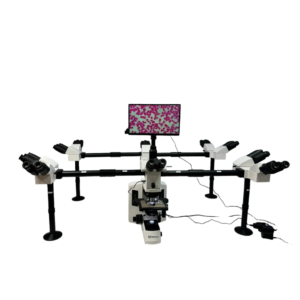
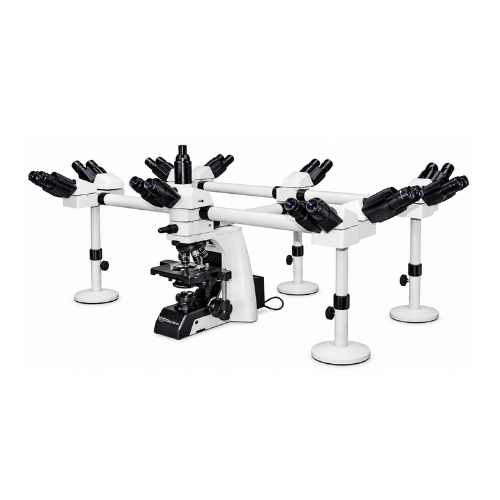
The OPXICA Deca Head Microscope OPX-129 is a multi-viewing microscope designed for simultaneous observation by multiple users. It combines a trinocular main viewing head with multiple binocular discussion heads, allowing teachers, researchers, technicians, and students to observe the same specimen at the same time.
Technical Specifications
| Parameter | Specification |
|---|---|
| Product Name | Deca Head Microscope OPX-129 |
| Brand | OPXICA |
| Microscope Type | Multi-Viewing Deca Head Microscope |
| Viewing System | Multi-Viewing System for up to 10 Observers |
| Main Viewing Head | Trinocular Head, 30° Inclined, 360° Rotatable |
| Discussion Head | Binocular Discussion Head |
| Head Configuration | 1 Dual Head + 8 Binocular Heads |
| Eyepieces | Wide-Field WF 10X |
| Field Number | FN 22 Main Head / FN 20 Discussion Head |
| Interpupillary Distance | 55–75 mm |
| Diopter Adjustment | Left-Side Diopter Adjustment |
| Optical System | Infinity Plan Achromatic Optical System |
| Objectives | Infinity Plan 4X/0.10, 10X/0.25, 40X/0.65, 100X/1.25 Oil |
| Objective Type | Infinity Plan Achromatic |
| Focusing System | Coaxial Coarse & Fine Focusing |
| Focus Graduation | 0.002 µm |
| Focus Safety | Upper Stop to Prevent Contact |
| Focus Tension | Adjustable |
| Illumination | Kohler Illumination |
| Light Source | 12V 100W Halogen Lamp |
| Cursor Illumination | LED Cursor |
| Brightness Control | Adjustable |
| Mechanical Stage | Double-Layer Mechanical Stage |
| Stage Size | 180 × 160 mm |
| Stage Travel | 80 × 50 mm |
| Slide Holder | Double Slide Holder |
| Condenser | Swing-Out Condenser |
| Condenser NA | N.A. 0.9 / N.A. 1.2 |
| Condenser System | Centering System |
| Viewing Capacity | Up to 10 Observers |
| Applications | Education, Laboratories, Research, Clinical & Industrial Applications |
Key Features
- Multi-viewing microscope designed for up to 10 simultaneous observers
- Trinocular main head with 30° inclination and 360° rotation
- 1 dual head and 8 binocular heads for group observation
- Wide-field WF 10X eyepieces
- FN 22 field number on the main head
- FN 20 field number on discussion heads
- 55–75 mm interpupillary adjustment for comfortable viewing
- Left-side diopter adjustment for individual focusing
- Infinity Plan Achromatic objectives for detailed specimen observation
- 4X, 10X, 40X and 100X oil immersion objectives
- Coaxial coarse and fine focusing mechanism
- Fine focus graduation of 0.002 µm
- Adjustable focusing tension for smooth operation
- Upper focus stop helps prevent accidental contact between the objective and specimen
- Kohler illumination for controlled and uniform specimen illumination
- 12V 100W halogen illumination system
- Adjustable brightness control
- LED cursor illumination
- Large 180 × 160 mm double-layer mechanical stage
- Stage movement of 80 × 50 mm
- Double slide holder for stable specimen positioning
- Swing-out condenser with N.A. 0.9 / 1.2
- Condenser centering system for accurate illumination
- Suitable for classroom demonstrations and group laboratory training
- Designed for educational, research, clinical and laboratory environments
Working Principle
The OPXICA Deca Head Microscope OPX-129 works on the principle of optical magnification and transmitted-light microscopy. The illumination system directs light through the specimen, while the condenser focuses and controls the light entering the sample.
The light passing through the specimen is collected by the selected Infinity Plan Achromatic objective. The objective magnifies the specimen image, which is then further viewed through the WF 10X eyepieces.
The Kohler illumination system helps provide controlled and uniform illumination across the specimen. Users can adjust the coarse and fine focusing controls to obtain a sharp image. The fine focusing mechanism allows precise adjustment, while the upper stop helps prevent the objective from making unintended contact with the specimen.
The main advantage of the OPX-129 is its multi-viewing optical system. The image from the microscope is distributed through the viewing heads, allowing multiple observers to examine the same specimen simultaneously. This makes the microscope suitable for teaching, practical demonstrations, collaborative observation, and group laboratory sessions.
Applications
The OPXICA Deca Head Microscope OPX-129 can be used in a range of educational and laboratory environments, including:
- School Biology Laboratories
- College Laboratories
- University Teaching Laboratories
- Medical Colleges
- Research Institutions
- Biology Training Centers
- Medical Training Centers
- Clinical Laboratories
- Pathology Training
- Microbiology Education
- Histology Education
- Life Science Laboratories
- Pharmaceutical Training
- Laboratory Demonstrations
- Collaborative Research
- Group Microscopy Sessions
Frequently Asked Questions (FAQs)
1. What is the OPXICA Deca Head Microscope OPX-129?
The OPXICA Deca Head Microscope OPX-129 is a multi-viewing microscope designed to allow up to 10 observers to examine the same specimen simultaneously. It is suitable for education, laboratory training, research and collaborative microscopy.
2. How many people can use the OPX-129 at the same time?
The microscope is designed for up to 10 observers. Its configuration includes 1 dual head and 8 binocular heads.
3. What type of viewing head does the OPX-129 have?
The main viewing system uses a 30° inclined trinocular head that can rotate through 360°. Additional binocular discussion heads are provided for multiple-user observation.
4. What eyepieces are used in the OPX-129?
The microscope uses wide-field WF 10X eyepieces. The main head has a Field Number of 22, while the discussion heads have a Field Number of 20.
5. What objectives are included?
The OPX-129 uses Infinity Plan Achromatic objectives with magnifications of:
- 4X / 0.10
- 10X / 0.25
- 40X / 0.65
- 100X / 1.25 Oil
6. What illumination system does the microscope use?
The microscope uses Kohler illumination with a 12V 100W halogen lamp. Brightness can be adjusted according to the observation requirements.
7. What is the function of the Kohler illumination system?
Kohler illumination helps provide controlled and uniform lighting of the specimen. This allows users to obtain consistent illumination while viewing samples through different objectives.
8. What type of focusing system is used?
The OPX-129 uses coaxial coarse and fine focusing. The focusing mechanism has a graduation of 0.002 µm, adjustable tension and an upper stop to help prevent accidental contact with the specimen.
9. What is the size of the mechanical stage?
The microscope has a 180 × 160 mm double-layer mechanical stage with a movement range of 80 × 50 mm. It also includes a double slide holder.
10. What type of condenser is provided?
The microscope is equipped with a swing-out condenser available with N.A. 0.9 or N.A. 1.2. It includes a centering system for proper alignment of the illumination.
11. Is the OPX-129 suitable for teaching laboratories?
Yes. Its multi-viewing design makes it particularly suitable for classroom demonstrations, practical training and group laboratory sessions, where several students or observers need to view the same specimen.
12. Can the OPX-129 be used for research?
Yes. The Infinity Plan Achromatic optical system, multiple magnification options, precision focusing and multi-observer configuration make it suitable for various laboratory and research environments.
13. What is the advantage of a Deca Head Microscope?
A Deca Head Microscope allows several users to observe one specimen simultaneously through separate viewing heads. This reduces the need to move or repeatedly prepare the specimen for different observers.
14. Who can use the OPXICA OPX-129?
The microscope can be used by schools, colleges, universities, medical institutions, research laboratories, training centers and other organizations that require multi-user microscopic observation.
15. Why choose the OPXICA Deca Head Microscope OPX-129?
The OPXICA OPX-129 combines a multi-observer viewing system, Infinity Plan Achromatic objectives, Kohler illumination, precision focusing and a large mechanical stage. Its configuration is designed for situations where multiple users need to observe and discuss the same microscopic specimen simultaneously.