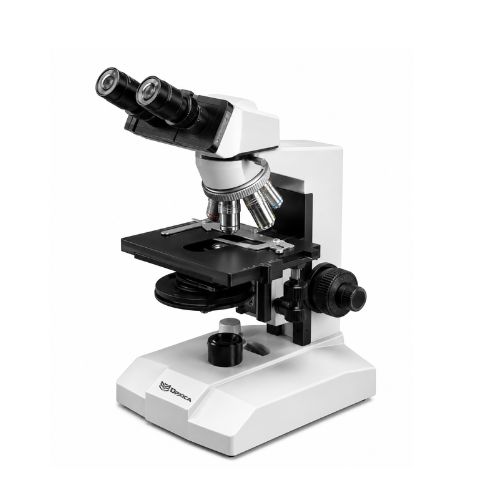
Description
Technical Specifications
| Parameter | Specification |
|---|---|
| Product Name | Phase Contrast Microscope OPX-174 |
| Brand | OPXICA |
| Microscope Type | Phase Contrast Microscope |
| Objective Type | Plan 45 mm DIN Achromatic Objectives |
| Objectives | 4X, 10X, 40X(S), 100X(S, Oil) |
| Eyepiece | Wide Field Plane-Scope WF10X |
| Optional Eyepiece | WF16X |
| Total Magnification | 40X–1600X |
| Viewing Head | Sliding Binocular Head |
| Viewing Head Angle | 45° Inclined |
| Head Rotation | 360° Rotatable |
| Interpupillary Distance | 55–75 mm |
| Mechanical Stage | Double-Layer Mechanical Stage |
| Stage Size | 140 × 155 mm |
| X-Y Movement | 70 × 50 mm |
| Iris Diaphragm | Ø2–Ø30 mm |
| Filter | Ø32 mm Filter |
| Condenser | Abbe Condenser, N.A. 1.25 |
| Focusing System | Coaxial Coarse & Fine Focusing |
| Focusing Travel | 25 mm |
| Focusing Precision | 0.002 mm |
| Illumination Options | Halogen 6V/20W, Incandescent 20W, Fluorescent 5W, LED 1W |
| Optional Illumination | LED Lamp with Rechargeable Device |
Key Features
- Phase contrast microscope designed for transparent and low-contrast specimens.
- Plan DIN Achromatic objectives for clear microscopic observation.
- 4X, 10X, 40X and 100X oil-immersion objective options.
- Wide-field WF10X eyepiece for comfortable viewing.
- Optional WF16X eyepiece available.
- 40X–1600X total magnification range.
- 45° inclined binocular head for ergonomic observation.
- 360° rotatable viewing head with 55–75 mm interpupillary adjustment.
- Large double-layer mechanical stage with precise X-Y movement.
- Abbe condenser with N.A. 1.25.
- Coaxial coarse and fine focusing mechanism.
- 25 mm focusing travel with 0.002 mm stated precision.
- Multiple illumination configurations available according to application requirements.
- Suitable for educational, research and laboratory microscopy.
Working Purpose
The OPXICA Phase Contrast Microscope OPX-174 is designed for observing specimens that have little natural contrast when viewed using conventional bright-field microscopy. Phase contrast techniques convert small differences in the optical properties of a specimen into visible intensity differences, making transparent structures easier to observe.
The microscope is particularly useful for examining unstained cells, microorganisms, tissue cultures and other transparent biological specimens where staining is undesirable or could alter the specimen.
Its binocular head provides comfortable direct observation, while the mechanical stage allows controlled specimen positioning. The available high-magnification objectives, including the 100X oil objective, support detailed microscopic examination.
Applications
The Phase Contrast Microscope OPX-174 is suitable for:
- Cell Biology
- Microbiology
- Biotechnology
- Tissue Culture Laboratories
- Biological Research
- Pharmaceutical Research
- Medical Research
- Clinical Laboratory Research
- Universities
- Medical Colleges
- Research Institutions
- Life Science Laboratories
- Educational Laboratories
- Water & Environmental Microbiology
- Pharmaceutical Laboratories
- Quality-Control Laboratories
Typical Specimens & Observations
The OPX-174 can be used for observing:
- Living cells
- Unstained biological specimens
- Cell cultures
- Microorganisms
- Bacteria
- Yeast
- Protozoa
- Tissue-culture samples
- Transparent cellular structures
- Thin biological specimens
Wrapping Notes
The OPXICA Phase Contrast Microscope OPX-174 combines a precision optical system with a comfortable binocular viewing configuration and mechanical specimen positioning. Its phase-contrast capability makes it suitable for observing transparent and low-contrast biological specimens, particularly when routine staining is not preferred.
With multiple objective configurations, up to 1600X total magnification, an Abbe condenser and precision coaxial focusing, the OPX-174 can be used in research laboratories, biotechnology facilities, microbiology laboratories, pharmaceutical institutions, universities and medical education environments.
Frequently Asked Questions (FAQs)
1. What is the Phase Contrast Microscope OPX-174 used for?
It is used primarily for observing transparent, unstained and low-contrast specimens, including living cells, microorganisms and tissue-culture samples.
2. What is phase contrast microscopy?
Phase contrast microscopy is a technique that converts differences in the phase of transmitted light caused by a specimen into visible differences in image brightness and contrast.
3. What objectives are available?
The specified objectives are 4X, 10X, 40X(S) and 100X(S, Oil) Plan DIN Achromatic objectives.
4. What is the magnification range?
The specified total magnification range is 40X–1600X, depending on the selected objective and eyepiece configuration.
5. Does the microscope have a binocular head?
Yes. It features a sliding binocular head, inclined at 45° and rotatable through 360°.
6. What is the interpupillary distance?
The interpupillary distance is adjustable from 55 to 75 mm.
7. What type of condenser is used?
The microscope uses an Abbe condenser with N.A. 1.25.
8. Can it be used for living cells?
Yes. Phase contrast microscopy is particularly useful for observing living and unstained cells, provided the specimen and culture conditions are appropriate.
9. Does it have a mechanical stage?
Yes. It has a double-layer mechanical stage measuring 140 × 155 mm, with 70 × 50 mm X-Y movement.
10. What illumination options are available?
The supplied configuration lists 6V/20W halogen, 20W incandescent, 5W fluorescent and 1W LED illumination options, along with an optional rechargeable LED configuration.
11. Is a 100X oil objective available?
Yes. The specified objective set includes a 100X(S, Oil) objective.
12. Where can the OPX-174 be used?
It is suitable for microbiology, cell biology, biotechnology, tissue culture, pharmaceutical research, medical research, universities and laboratory education.