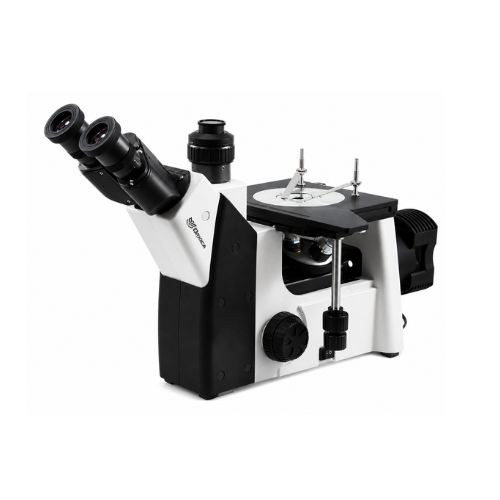
Description
Technical Specifications
| Parameter | Specification |
|---|---|
| Product Name | Inverted Metallurgical Microscope OPX-175 |
| Brand | OPXICA |
| Microscope Type | Inverted Metallurgical Microscope |
| Optical System | Infinite Optical System, Color Corrected, Anti-Fungal & Anti-Bacterial Multi-Layer Hard Coated |
| Objective Configuration | Color-Coded, Parfocal (60 mm), Pre-Centered Objectives |
| Viewing Head | Trinocular Siedentopf Head, 45° Inclined, 360° Rotatable |
| Interpupillary Distance | 54–75 mm |
| Diopter Adjustment | Adjustable |
| Camera Port Splitting | 20:80 |
| Nosepiece | Inward-Tilted Quintuple Revolving Nosepiece with Multiple Ball Bearings |
| Eyepieces | Paired High-Eye-Point WF10X, FOV 20 mm |
| Eyepiece Coating | Multi-Layer Coated |
| Eyepiece Adjustment | Diopter Adjustment on Both Eyepieces ±5 mm |
| Mechanical Stage | Three-Ply Large Graduated Mechanical Stage |
| Stage Size | 180 × 155 mm |
| Stage Support | Three-Point Support |
| Stage Movement | 75 × 40 mm |
| Stage Control | Right-Hand Low-Position Coaxial Control |
| Stage Plate | Metal Stage Plate |
| Center Hole | Ø12 mm |
| Objectives | 10X Plan Achromatic, N.A. 0.25, W.D. 8.7 mm; 20X Plan Achromatic, N.A. 0.40, W.D. 8.8 mm; 50X Plan Achromatic, N.A. 0.60, W.D. 5.1 mm |
| Objective Type | Infinite Plan Achromatic |
| Reflected Illumination | Reflection Köhler Illumination |
| Illumination Control | Iris Diaphragm & Centerable Field Diaphragm |
| Light Source | Halogen 6V/30W |
| Lamp Life | Approx. 2000 Hours |
| Light Intensity | Continuous Intensity Control |
| Focusing System | Low-Position Coaxial Coarse & Fine Adjustment |
| Focusing Stopper | Upper Limit Stopper |
| Coarse Adjustment | Tightness Adjustment |
| Coarse Travel Range | 38 mm |
| Fine Adjustment Precision | 2 µm |
| Focusing Mechanism | Slide Travelling on Bearing Guideways |
| Power Supply | Built-In SMPS Based Wide Voltage Range |
| Input Voltage | 90V–240V, 50/60 Hz |
| Filters | Ø32 mm Yellow / Green / Blue / ND |
| Stage Inserts | Round Stage Inserts with Ø10 mm, Ø15 mm & Ø25 mm Openings |
Key Features
- Inverted configuration specifically designed for metallurgical and material examination.
- Infinite optical system for high-quality microscopic imaging.
- Color-corrected optical system for accurate specimen observation.
- Multi-layer hard coating with anti-fungal and anti-bacterial treatment.
- Trinocular Siedentopf viewing head inclined at 45° for ergonomic operation.
- 360° rotatable viewing head with adjustable interpupillary distance.
- 20:80 trinocular light-splitting configuration for digital imaging.
- Quintuple inward-tilted revolving nosepiece supported by multiple ball bearings.
- High-eye-point WF10X/20 mm eyepieces with multi-layer optical coating.
- Large 180 × 155 mm graduated mechanical stage.
- 75 × 40 mm X-Y stage movement for precise specimen positioning.
- Reflection Köhler illumination for controlled and uniform reflected-light observation.
- Continuous illumination intensity control.
- 10X, 20X and 50X Infinite Plan Achromatic metallurgical objectives.
- Coaxial coarse and fine focusing positioned for convenient operation.
- 2 µm fine focusing precision as specified.
- Built-in wide-voltage SMPS power supply supporting 90V–240V.
- Multiple color and neutral-density filter options.
- Robust ergonomic construction with rubber feet for stable operation.
Working Purpose
The OPXICA Inverted Metallurgical Microscope OPX-175 is developed for detailed microscopic examination of metals, alloys, polished surfaces, coatings, composites and other opaque industrial specimens.
The inverted design is particularly useful when the specimen is too large, heavy, or irregular to conveniently place beneath a conventional upright microscope objective. The specimen can be positioned on the large mechanical stage while the optical system observes the surface from below.
Its reflected Köhler illumination provides controlled lighting for metallographic observation, while the Plan Achromatic objectives help provide a flat and well-corrected field of view across the specimen.
The trinocular configuration also permits connection of a microscope camera for digital image capture, documentation, measurement, reporting and laboratory records.
Applications
The OPX-175 is suitable for:
- Metallurgical Laboratories
- Materials Testing Laboratories
- Steel Manufacturing
- Metal Industries
- Foundries
- Automotive Industries
- Aerospace Component Inspection
- Engineering Industries
- Mechanical Engineering Laboratories
- Casting Inspection
- Welding Inspection
- Heat Treatment Analysis
- Failure Analysis
- Surface Inspection
- Coating Analysis
- Industrial Quality Control
- Research & Development
- Material Science Laboratories
- Universities
- Engineering Colleges
- Manufacturing Inspection
Typical Examination Areas
The microscope can be used for examination of:
- Metal microstructures
- Steel and alloy specimens
- Grain structures
- Cast materials
- Welded joints
- Heat-treated specimens
- Polished metal surfaces
- Coatings and plated surfaces
- Material inclusions
- Surface defects
- Industrial components
- Metallographic samples
- Material phases and structural characteristics
Standard Accessories
| Accessory | Specification |
|---|---|
| Cleaning Cloth | For optical and microscope surface cleaning |
| Vinyl Cover | Protective microscope cover |
| Allen Keys | Maintenance and adjustment tools |
| Round Stage Inserts | Ø10 mm, Ø15 mm & Ø25 mm openings |
| Filters | 32 mm Yellow / Green / Blue / ND |
| Fuses | 2 Nos. |
| Instruction Manual | User operating manual |
| Warranty Card | Warranty documentation |
| Power Cord | Country-specific power cord |
Wrapping Notes
The OPXICA Inverted Metallurgical Microscope OPX-175 combines an inverted optical configuration, infinite Plan Achromatic objectives, reflected Köhler illumination and a large mechanical stage for professional metallographic and industrial inspection applications.
Its large stage area and inverted design make it suitable for examining large or difficult-to-handle opaque specimens, while the trinocular head provides an option for digital documentation and image analysis. The robust focusing mechanism, precision stage movement and wide-voltage power supply make it suitable for demanding laboratory and industrial environments.
Frequently Asked Questions (FAQs)
1. What is the OPX-175 used for?
The OPX-175 is designed for metallography, material examination, industrial inspection, quality control and research involving metals and other opaque specimens.
2. What is an inverted metallurgical microscope?
An inverted metallurgical microscope has its optical system positioned below the specimen stage. This configuration allows users to place large, heavy or irregular specimens directly on the stage for examination.
3. What objectives are included?
The specified objective configuration includes 10X, 20X and 50X Infinite Plan Achromatic objectives.
4. What is the numerical aperture of the objectives?
The specified N.A. values are:
- 10X: N.A. 0.25
- 20X: N.A. 0.40
- 50X: N.A. 0.60
5. Does the microscope support digital imaging?
Yes. The microscope has a trinocular head with 20:80 light splitting, allowing a compatible microscope camera to be connected.
6. What illumination system does it use?
It uses reflection Köhler illumination with a 6V/30W halogen lamp, iris diaphragm, centerable field diaphragm and continuous intensity control.
7. What is the stage size?
The mechanical stage measures 180 × 155 mm and provides 75 × 40 mm X-Y movement.
8. What type of focusing system is provided?
The OPX-175 features low-position coaxial coarse and fine focusing, with a 38 mm coarse adjustment range and specified fine adjustment precision of 2 µm.
9. What type of eyepieces are used?
It uses paired high-eye-point WF10X eyepieces with a 20 mm field of view, with diopter adjustment on both eyepieces.
10. Is it suitable for large metallographic specimens?
The inverted configuration and large mechanical stage are particularly useful when working with large, heavy or irregularly shaped specimens, subject to the stage’s physical load and clearance limits.
11. What power supply does it use?
The built-in SMPS supports a wide input range of 90V–240V, 50/60 Hz.
12. Can the microscope be used for quality control?
Yes. It is suitable for industrial quality control, metallographic inspection, material testing and manufacturing inspection.