
How to Choose Right Microscope Manufacturer in India
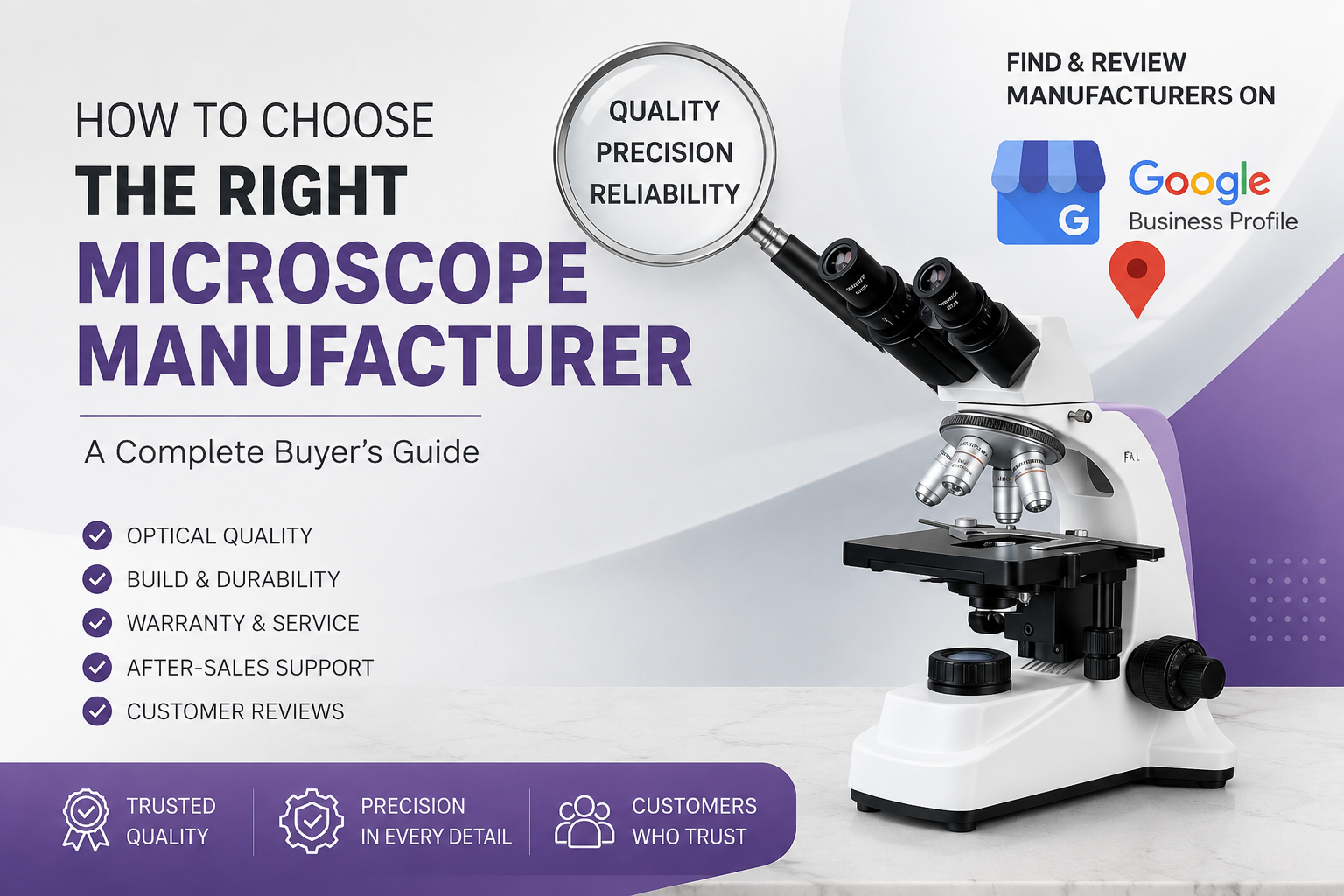
Choosing the right microscope manufacturer in India is an important decision for laboratories, hospitals, educational institutions, research centres, pathology labs, industrial facilities, and distributors. A microscope is not simply a piece of laboratory equipment. Its optical quality, mechanical performance, durability, service support, and availability of spare parts can directly affect the accuracy and efficiency of your work.
With many microscope manufacturers, suppliers, dealers, and distributors available in India, finding a reliable company can sometimes be confusing. One practical way to begin your search is through Google Maps and Google Business Profiles. However, the company appearing at the top should not automatically be considered the best manufacturer. Instead, use Google Maps as a starting point to shortlist companies and then evaluate them based on reviews, manufacturing capabilities, product range, technical specifications, warranty, after-sales service, and customer support.
Here is a practical guide to help you choose the right microscope manufacturer in India.
1. Start Your Search on Google Maps
This example shows how searching “Microscope Manufacturer in India” on Google can help you discover and shortlist relevant microscope manufacturers for further evaluation.
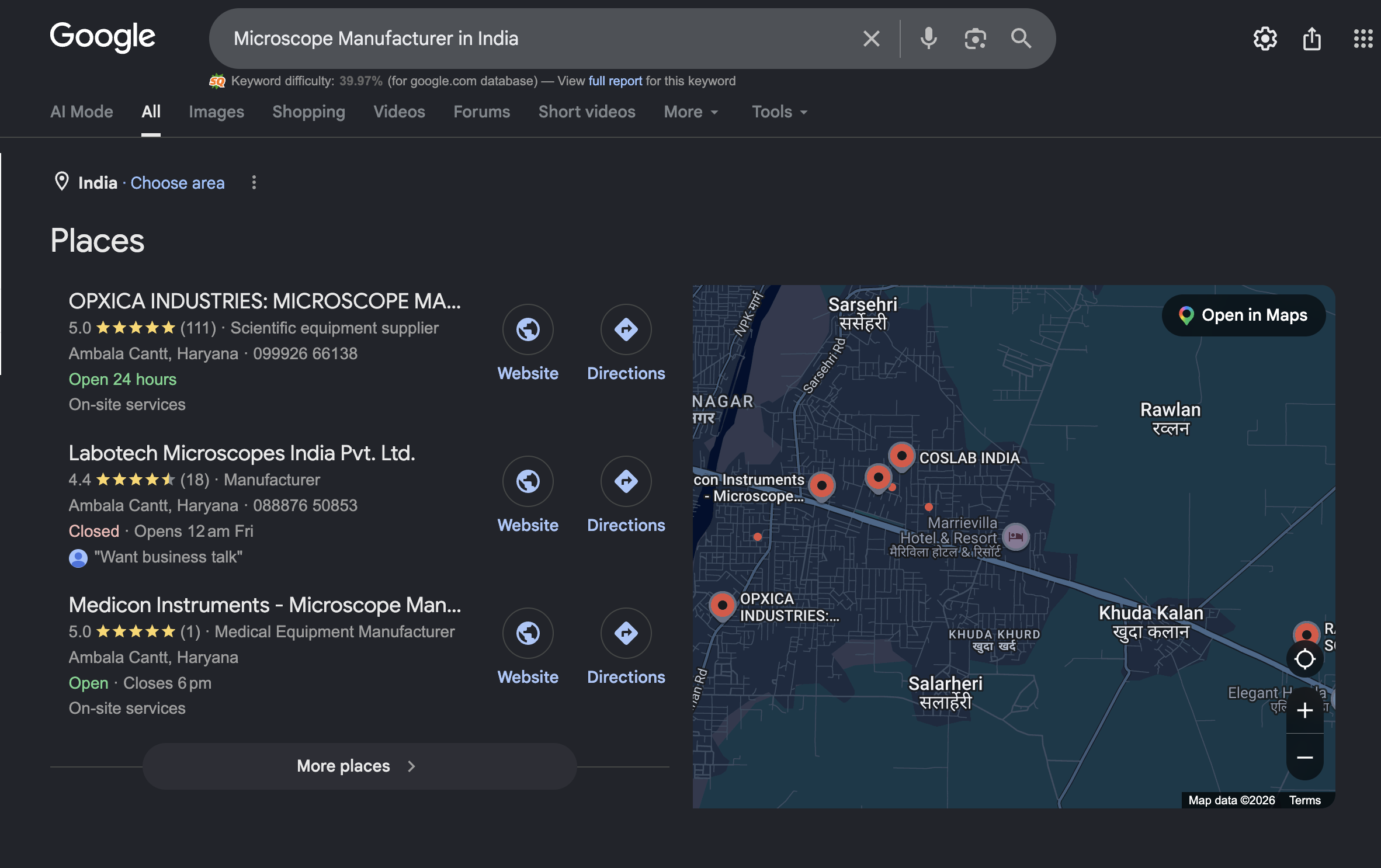
When looking for a microscope manufacturer, begin with relevant Google searches and Google Maps.
You can search terms such as:
- Microscope Manufacturer in India
- Microscope Manufacturer Near Me
- Laboratory Microscope Manufacturer
- Biological Microscope Manufacturer
- Digital Microscope Manufacturer
- Research Microscope Manufacturer
- Industrial Microscope Manufacturer
Google Maps can help you discover companies that have an established business profile, customer reviews, contact details, location information, photographs, website links, and other business information.
The companies appearing near the top can be added to your initial shortlist. However, Google Maps ranking should be treated as a discovery and shortlisting method, not as proof that a company is the best manufacturer.
2. Check Google Reviews Before Contacting the Manufacturer
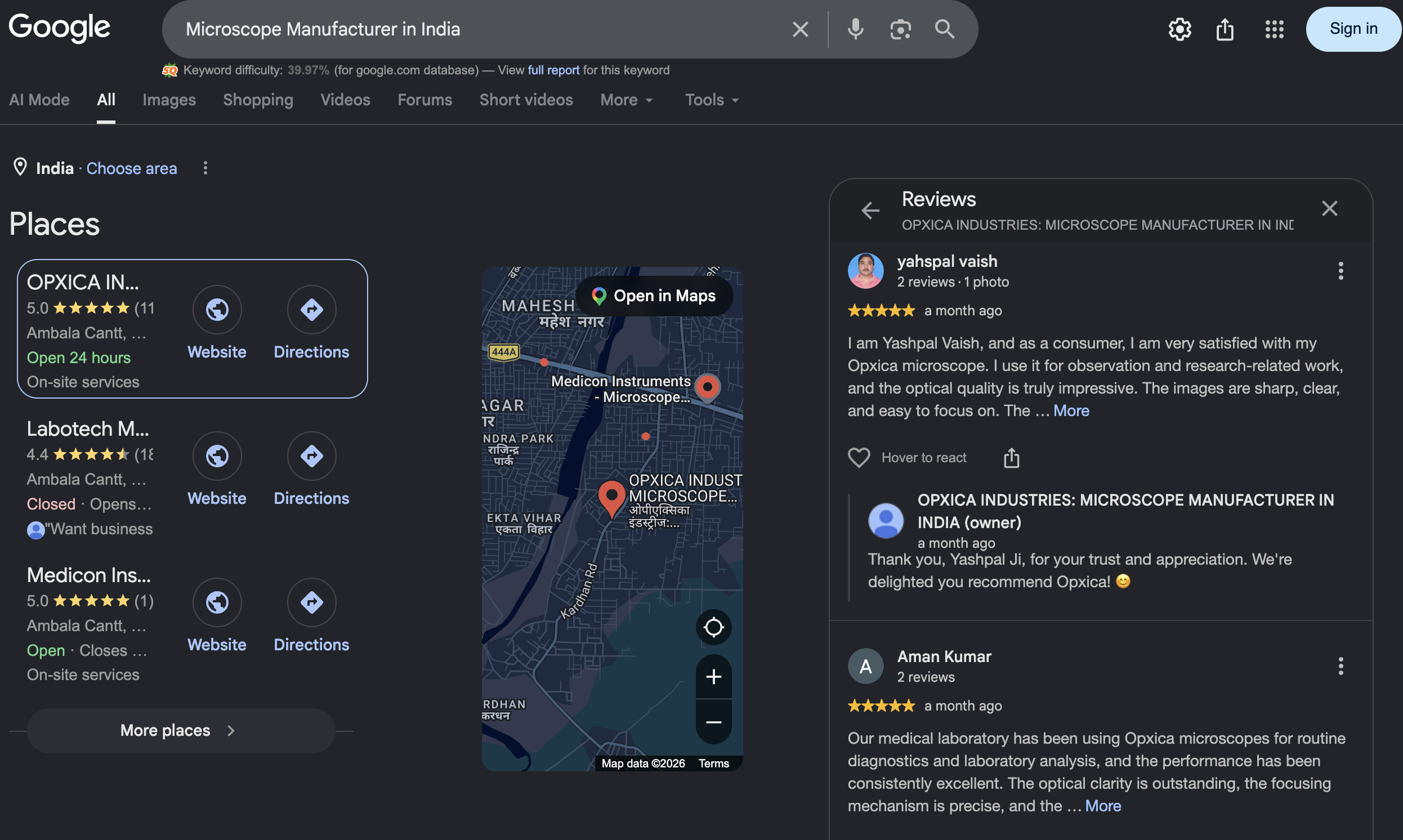
Customer reviews can provide useful information about a company’s products and services.
Do not focus only on the star rating. Look at:
- Number of reviews
- Recent reviews
- Detailed customer feedback
- Product quality comments
- Delivery experience
- Customer service
- Technical support
- Warranty experience
- Installation and demonstration feedback
For example, a company with a strong rating and hundreds of detailed reviews may provide more information for evaluation than a profile with a similar rating but very few reviews.
Also, read the actual reviews instead of relying only on the rating.
Look for comments related to microscope quality, optical performance, delivery, service response, packaging, and after-sales support.
3. Verify Whether the Company Is Actually a Manufacturer
This is one of the most important steps.
The term “microscope manufacturer” is used by many businesses, but not every company operates its own manufacturing facility. Some businesses may work primarily as distributors, dealers, traders, or resellers.
Before placing a large order, try to verify the company’s manufacturing capability.
Check whether the company provides:
- Manufacturing facility details
- Factory photographs
- Product assembly information
- Technical team information
- Company history
- Product catalogue
- Manufacturing address
- Quality-control information
- Product documentation
- Business registration details
If possible, ask the manufacturer directly about its manufacturing process and whether the requested microscope is manufactured or sourced by the company.
For institutional and bulk purchases, this verification can help reduce the risk of dealing with an unsuitable supplier.
4. Compare the Manufacturer’s Microscope Product Range
A reliable microscope manufacturer should ideally have a product portfolio suitable for different applications.
Depending on your requirements, you may need:
- Compound Microscopes
- Binocular Microscopes
- Trinocular Microscopes
- Digital Microscopes
- Stereo Microscopes
- Research Microscopes
- Metallurgical Microscopes
- Fluorescence Microscopes
- Pathology Microscopes
- Industrial Microscopes
- Student Microscopes
- Polarizing Microscopes
A broad product range can be useful when an organization needs different microscope configurations for multiple departments or applications.
However, a large catalogue alone does not prove quality. Always evaluate the specifications and application suitability of the individual model.
5. Check Optical Specifications Carefully
The optical system is one of the most important components of a microscope.
Do not choose a microscope only because it offers a high magnification such as 1000X or 2000X. Higher magnification does not automatically mean better image quality.
Before purchasing, check specifications such as:
- Objective lenses
- Eyepiece specifications
- Numerical aperture
- Optical system
- Magnification range
- Illumination system
- Condenser
- Mechanical stage
- Focusing mechanism
- Working distance
- Camera compatibility
For research, pathology, educational, or industrial applications, the optical configuration should match the intended use.
A manufacturer that can clearly explain these specifications is generally more useful than a seller that focuses only on price and magnification.
6. Ask About Customization Options
Different laboratories and industries may require different microscope configurations.
For example, a laboratory may require a trinocular microscope with camera integration, while an educational institution may need a simple binocular microscope.
Depending on the application, ask whether the manufacturer can provide:
- Different objective configurations
- Digital camera integration
- Trinocular heads
- LED illumination
- Mechanical stages
- Additional eyepieces
- Specialized objectives
- Image-analysis compatibility
- Customized accessories
Customization can be particularly useful for research laboratories, industrial inspection, medical applications, and specialized educational requirements.
7. Evaluate Build Quality and Mechanical Components
Optical performance is important, but mechanical construction also affects the long-term usability of a microscope.
When comparing manufacturers, examine:
- Body construction
- Stage stability
- Focusing mechanism
- Nosepiece quality
- Ergonomic design
- Illumination system
- Adjustment controls
- Overall finishing
- Stability during operation
A microscope that is used for several hours every day should be comfortable and mechanically reliable.
For professional applications, a stable mechanical system can make routine observation more efficient and reduce operational problems.
8. Compare Warranty and After-Sales Service
A microscope is a long-term investment. Therefore, after-sales service should be considered before purchasing.
Ask the manufacturer:
- What is the warranty period?
- What components are covered?
- Is installation included?
- Is product demonstration available?
- Are spare parts available?
- Is technical support provided?
- Is on-site service available?
- Is AMC available?
- How quickly are service requests handled?
A manufacturer offering strong after-sales support can provide more value over the complete product lifecycle than a company offering only a lower initial price.
9. Check Spare Parts Availability
Spare parts are an important consideration, especially for laboratories and institutions that use microscopes for many years.
Ask about the availability of:
- Objectives
- Eyepieces
- Mechanical stages
- Condensers
- LED modules
- Power supplies
- Camera adapters
- Focusing components
- Other replacement parts
Before purchasing, ask how long spare parts are expected to remain available for the selected model.
10. Request a Detailed Quotation
Once you have shortlisted manufacturers, contact at least two or three companies and request detailed quotations.
Do not compare prices alone.
Your quotation comparison should include:
| Factor | What to Compare |
|---|---|
| Microscope Model | Exact model number |
| Optical System | Optical configuration |
| Objectives | Type and magnification |
| Eyepieces | Specifications |
| Illumination | LED/other system |
| Accessories | Included accessories |
| Camera | Included or optional |
| Warranty | Coverage and duration |
| Service | Support terms |
| Delivery | Expected timeline |
| Taxes | Applicable taxes |
| Spare Parts | Availability |
| Price | Final quotation |
This approach gives you a much clearer understanding of the actual value offered by each manufacturer.
11. Ask for Product Demonstration
If possible, request a product demonstration before purchasing expensive microscopes.
A demonstration can help you evaluate:
- Image clarity
- Focusing smoothness
- Stage movement
- Illumination quality
- Optical performance
- Ergonomics
- Camera output
- Ease of operation
For institutions purchasing multiple microscopes, a demonstration can be particularly useful before finalizing a bulk order.
12. Check the Manufacturer’s Website and Online Presence
A professional website can provide additional information about the company.
Look for:
- Product catalogue
- Technical specifications
- Company information
- Manufacturing details
- Contact information
- Application areas
- Product manuals
- Certifications
- Customer support information
Also compare the information on the website with the company’s Google Business Profile.
If the business claims to be a manufacturer, the website should ideally provide enough information to understand its products and capabilities.
13. Do Not Select a Manufacturer Only Because It Is Ranked #1 on Google Maps
This point deserves special attention.
Suppose you search:
“Microscope Manufacturer in India”
and several companies appear in Google Maps.
It can be tempting to contact the first company and assume that it is the best option.
That is not necessarily the right approach.
Google Maps ranking is influenced by several factors, and ranking position alone does not establish manufacturing quality, optical performance, pricing, warranty, or technical expertise.
Instead, use the following process:
Google Maps Search → Shortlist Companies → Read Reviews → Verify Manufacturer → Compare Products → Check Specifications → Request Quotations → Evaluate Service → Make Final Decision
This is a much safer and more professional approach.
14. Shortlist 3–5 Microscope Manufacturers
Instead of contacting only one company, create a shortlist.
For example:
Company A: Strong Google reviews and wide product range
Company B: Specialized microscope manufacturer
Company C: Competitive pricing and strong service
Company D: Good technical specifications
Company E: Suitable for customized requirements
Then contact the shortlisted manufacturers and compare their responses.
This gives you better negotiating power and helps you identify which company actually understands your requirements.
15. Choose the Manufacturer Based on Your Application
The “best” microscope manufacturer is not necessarily the same for every buyer.
For example:
Educational Institution:
Focus on durability, ease of operation, affordability, and basic optical performance.
Pathology Laboratory:
Focus on optical clarity, ergonomics, objectives, reliability, and service support.
Research Laboratory:
Focus on advanced optics, customization, camera integration, specialized objectives, and technical support.
Industrial Application:
Focus on working distance, magnification, illumination, mechanical stability, and application-specific accessories.
Distributor or Dealer:
Focus on product range, pricing, supply capacity, margins, documentation, warranty, and long-term manufacturer support.
Therefore, define your application before choosing a manufacturer.
A Simple Checklist for Choosing a Microscope Manufacturer
Before placing your order, ask yourself:
- Is the company genuinely involved in microscope manufacturing?
- Does it have relevant Google reviews?
- Are the reviews recent and detailed?
- Does the company offer the microscope type I need?
- Are the optical specifications suitable?
- Can the microscope be customized?
- Is technical support available?
- What warranty is provided?
- Are spare parts available?
- Can the manufacturer provide a demonstration?
- Is the quotation detailed?
- Does the company have experience with similar customers?
- Can the manufacturer support future requirements?
If most of these questions have satisfactory answers, the company can be considered for the next stage of evaluation.
Ending
Finding the right microscope manufacturer in India does not have to be complicated, but it should not be based on one factor either.
Google Maps is a useful place to start your search. Search for relevant terms such as “Microscope Manufacturer in India,” shortlist companies with established business profiles, study their reviews, and then verify their manufacturing capabilities.
After that, compare their product range, optical specifications, build quality, customization options, warranty, spare parts, technical support, and quotations.
Most importantly, do not assume that the company ranking at the top of Google Maps is automatically the best manufacturer. Use Google Maps to discover potential manufacturers, then use technical and business criteria to make the final decision.
A systematic approach can help laboratories, hospitals, educational institutions, research organizations, industries, and distributors select a microscope manufacturer that offers the right combination of quality, technology, reliability, pricing, and long-term support.
When you shortlist manufacturers, contact multiple companies, explain your exact application, request technical specifications and quotations, and compare the complete offering before making your final purchase decision.
