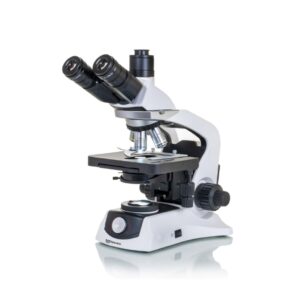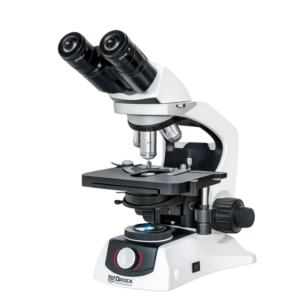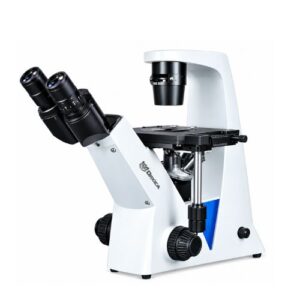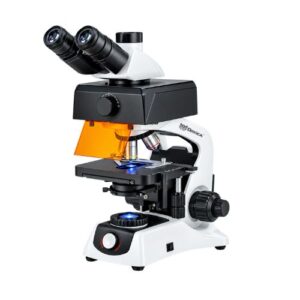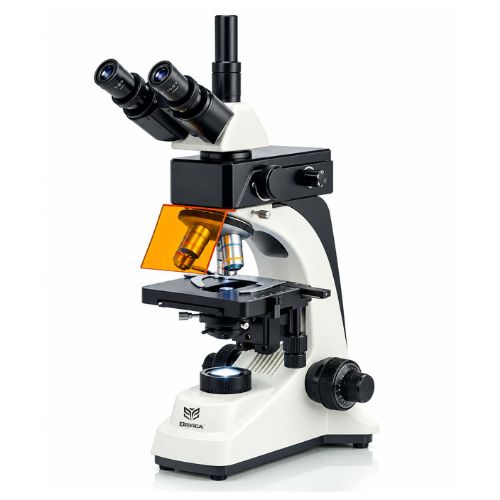
Description
Technical Specifications
| Parameter | Specification |
|---|---|
| Product Name | Fluorescent Microscope OPX-256 |
| Model Number | OPX-256 |
| Microscope Type | Fluorescent Laboratory Microscope |
| Optical System | Plan Achromatic Optics with Antifungal & Anti-Reflection Coating |
| Magnification | 40X, 100X, 400X, 1000X |
| Optional Magnification | 600X and 800X |
| Observation Head | Seidentopf Binocular/Trinocular |
| Head Inclination | 30° Inclined |
| Head Rotation | 360° Swivelling |
| Interpupillary Distance | 48–75 mm |
| Trinocular Tube | Three-Way Trinocular Tube for Simultaneous Camera & Eyepiece Observation |
| Eyepiece | Wide Field 10X |
| Field of View | 25 mm |
| Eyepiece Features | Antifungal Coating & Rubber Eyecups |
| Nosepiece | Quadruple Revolving Nosepiece |
| Mechanical Stage | 210 × 140 mm |
| Stage Travel | X/Y: 90 × 70 mm |
| Stage Surface | Hard Ceramic Surface |
| Slide Holder | Dual Slide Holder |
| Stage Division | 0.1 mm |
| Stage Drive | Low-Drive Mechanical Movement |
| Upper Limit | Adjustable Upper Limit Stopper |
| Objectives | Plan-Achromat / HI PLAN |
| 4X Objective | NA 0.10 |
| 10X Objective | NA 0.25 |
| 40X Objective | NA 0.65 |
| 100X Objective | NA 1.30 |
| Condenser | Swing-Out / Universal Condenser |
| Condenser NA | 0.90 |
| Condenser Diaphragm | Iris Diaphragm |
| Condenser Coating | Antifungal & Anti-Reflection Coated |
| Observation Modes | Bright Field, Phase Contrast & Fluorescence |
| Focusing System | Coaxial Coarse & Fine Focusing |
| Focusing Mechanism | Two-Step Smooth Gear Operation |
| Transmitted Illumination | 10W LED |
| LED Control | Variable Intensity Control |
| LED Life | Up to 60,000 Hours |
| Power Supply | 110–240V AC |
| Battery Backup | Optional |
| Fluorescent Illumination | LED-Based Fluorescence Illumination |
| Fluorescence Control | Intensity Controller |
| Fluorescent LED Life | Up to 60,000 Hours |
| Fluorescence Filter | Single Immunofluorescence Filter |
| Brand | OPXICA |
Key Features
Advanced Plan Achromatic Optical System
The OPX-256 uses plan-achromatic optics designed to provide clear and well-corrected images across the viewing field. Antifungal and anti-reflection coatings help maintain optical performance during laboratory use.
Fluorescence Observation
The microscope incorporates an LED-based fluorescence illumination system with intensity control for fluorescence-based specimen observation and laboratory applications.
Binocular & Trinocular Configuration
The Seidentopf observation head is available in binocular/trinocular configuration. The trinocular version allows a microscope camera to be used simultaneously with eyepiece observation.
Wide Magnification Range
The microscope supports 40X to 1000X magnification, with optional 600X and 800X configurations, making it suitable for routine biological observation as well as higher-magnification laboratory examination.
Plan-Achromat Objectives
The objective set includes:
- 4X — NA 0.10
- 10X — NA 0.25
- 40X — NA 0.65
- 100X — NA 1.30
The 100X objective provides high-resolution observation and is suitable for detailed microscopic examination.
Large Ceramic Mechanical Stage
The 210 × 140 mm mechanical stage provides a stable platform for specimen positioning. Its hard ceramic surface, dual slide holder, and 90 × 70 mm X/Y movement support precise specimen handling.
Universal Condenser
The swing-out/universal condenser has NA 0.90 and an iris diaphragm. It supports bright-field, phase-contrast, and fluorescence-related microscopy configurations.
Long-Life LED Illumination
The 10W transmitted LED illumination system offers adjustable intensity and an expected LED life of up to 60,000 hours, providing efficient and consistent illumination.
Precision Coaxial Focusing
The two-step coaxial coarse and fine focusing mechanism enables smooth specimen focusing and precise image adjustment.
Working Purpose
The Fluorescent Microscope OPX-256 is developed for microscopic examination of biological and fluorescent specimens where conventional bright-field observation alone may not provide sufficient information.
It is suitable for:
- Fluorescence microscopy
- Cell biology
- Microbiology
- Immunofluorescence studies
- Tissue examination
- Histological studies
- Molecular biology research
- Pharmaceutical research
- Biotechnology research
- Clinical laboratory research
- Educational microscopy
- Scientific research
Applications
Biotechnology Laboratories
Used for cellular and fluorescence-based investigations in biotechnology research.
Microbiology Laboratories
Suitable for observing microorganisms and prepared biological specimens using appropriate microscopy techniques.
Medical & Clinical Research
Can be used for research-oriented examination of tissues, cells, and fluorescently labelled specimens.
Pharmaceutical Research
Useful for laboratory research involving cells, microorganisms, tissues, and fluorescence-based assays.
Universities & Research Institutes
Suitable for teaching, demonstrations, practical training, and advanced biological research.
Immunofluorescence Applications
The fluorescence configuration can be used with appropriate fluorescent labels and filter arrangements for immunofluorescence-based observation.
Advantages of OPX-256
- Plan-achromatic optical system
- Antifungal optical coating
- Anti-reflection coated optics
- Binocular/trinocular viewing options
- 360° swivelling observation head
- 48–75 mm interpupillary adjustment
- 40X–1000X magnification
- Optional 600X and 800X magnification
- Plan-achromat / HI PLAN objectives
- Large 210 × 140 mm mechanical stage
- Ceramic stage surface
- Dual slide holder
- 10W variable LED illumination
- LED fluorescence illumination
- Up to 60,000-hour LED life
- Bright-field and phase-contrast capability
- Fluorescence observation capability
- Coaxial coarse and fine focusing
- 110–240V AC operation
- Optional battery backup
Frequently Asked Questions (FAQs)
1. What is a fluorescent microscope?
A fluorescent microscope is an optical microscope that uses specific illumination and fluorescence filters to observe specimens containing fluorescent materials or fluorescent labels. It is commonly used in biological, microbiological, pharmaceutical, biotechnology, and research laboratories.
2. What is the magnification range of the OPX-256?
The OPX-256 provides 40X to 1000X magnification using the supplied eyepiece and objective combinations. Optional 600X and 800X configurations can also be provided.
3. What objectives are supplied with the OPX-256?
The standard objective configuration includes:
- 4X NA 0.10
- 10X NA 0.25
- 40X NA 0.65
- 100X NA 1.30
4. Can the OPX-256 be used for bright-field microscopy?
Yes. The OPX-256 includes a transmitted LED illumination system and condenser suitable for bright-field observation.
5. Can the OPX-256 perform phase-contrast microscopy?
Yes. The universal condenser configuration supports phase-contrast applications when the appropriate phase-contrast accessories are installed.
6. Can a camera be connected to the OPX-256?
Yes. The trinocular configuration provides a dedicated optical path for connecting a compatible microscope camera while allowing simultaneous eyepiece observation.
7. What type of illumination is used?
The microscope uses 10W LED transmitted illumination and a separate LED-based fluorescence illumination system. Both systems are designed for efficient laboratory operation.
8. What is the expected LED life?
The specified LED life is up to 60,000 hours, subject to operating conditions and proper equipment use.
9. What is immunofluorescence microscopy?
Immunofluorescence microscopy uses fluorescently labelled antibodies or related probes to help visualize specific biological targets. The OPX-256 can be configured for suitable fluorescence applications using the appropriate filter and fluorescent-label combination.
10. What type of specimens can be examined?
Depending on the microscopy technique and preparation, the OPX-256 can be used for:
- Cells
- Tissue sections
- Microorganisms
- Biological samples
- Fluorescently labelled specimens
- Histological preparations
- Research samples
11. Is the OPX-256 suitable for research laboratories?
Yes. Its fluorescence capability, plan-achromatic optics, trinocular configuration, mechanical stage, and multiple observation modes make it suitable for biological and life-science research environments.
12. Is the microscope suitable for educational institutions?
Yes. The OPX-256 can be used in universities, colleges, biotechnology institutes, medical research centers, and advanced teaching laboratories where fluorescence and conventional microscopy techniques are required.
13. What is the stage size of the OPX-256?
The microscope features a 210 × 140 mm mechanical stage with 90 × 70 mm X/Y travel, a hard ceramic surface, and dual slide-holder arrangement.
14. Does the microscope have adjustable illumination?
Yes. The transmitted 10W LED illumination includes variable intensity control. The fluorescence illumination system also includes an intensity controller.
15. What is the difference between a normal biological microscope and a fluorescent microscope?
A conventional biological microscope primarily relies on transmitted or reflected visible light for specimen observation. A fluorescent microscope additionally uses fluorescence excitation and appropriate optical filtering to visualize fluorescent signals within or on a specimen.
16. How should the OPX-256 be maintained?
For reliable performance:
- Clean optical surfaces with suitable lens-cleaning materials.
- Avoid touching lenses with bare fingers.
- Keep the microscope covered when not in use.
- Store it in a clean and dry environment.
- Keep the stage free from dust and specimen residue.
- Handle fluorescence filters and optical components carefully.
- Check illumination and focusing systems periodically.
17. Is the OPX-256 available for institutional and bulk orders?
Yes. OPXICA can supply the Fluorescent Microscope OPX-256 for universities, research institutes, hospitals, biotechnology laboratories, pharmaceutical companies, distributors, and other institutional requirements.
18. Where can I buy the OPXICA Fluorescent Microscope OPX-256?
The OPXICA Fluorescent Microscope OPX-256 can be purchased directly from OPXICA. Contact the OPXICA sales team for current pricing, availability, institutional quotations, camera options, accessories, and technical support.